"Osiris is a black god!"
Notes on feeling like an (increasingly?) weirdo reader

In Illuminatus!, a TWA stewardess finds a series of long gnomic notes in a “seat vacated by a Mr. ‘John Mason’ after a Madison, Wisconsin to Mexico City flight, June 29, 1969, one week after the last SDS convention of all time.” These seem like some paranoid intellectual’s links they (or you or I) need to trace at the library or elsewhere. There are notes and allusions about Dillinger; Christianity and 3s, Buddhism and 4s, Illuminati and 5s; Lovecraft; Hopi anthropology; “illumination” and “enlightenment”; Pynchon’s Crying of Lot 49; “Kick out the jams;” why the Pentagon has five sides: who decided this? Etc.1
The same enthusiastic explorer then adds this:
What gets me is how much has been out in the open for so long. Not just in Lovecraft, Joyce, Melville, etc., or in the Bugs Bunny cartoons but in scholarly works that pretend to explain. Anybody who wants to go to the trouble can find out, for instance, that the “secret” of the Eleusinian Mysteries was the words whispered to the novice after he got the magic mushroom, “Osiris is a black god!” Five words (of course!) but no historian, archaeologist, anthropologist, folklorist, etc, has understood. Or, those who did understand, didn’t care to admit it.2
Many years ago I would use “Osiris is a black god!” as a postscript to emails to confidants. It felt like an in-group joke, enigmatic and a nudge-nudge a nod is as good as a wink to a blind bat, innit? kinda thang. Then someone replied, “I don’t know what that (the Osiris bit) means.” So Imma explain an explanation, and it really has to do with the kind of weirdo reader I think most of y’all are, or why are you reading this Substack?
-Speak for yourself, schmuck. Who ya callin’ a weirdo reader?
-Okay: point taken. I will speak for myself. I’m a weirdo, she’s an eccentric, you’re an erudite. It’s all, like, semantics, man!
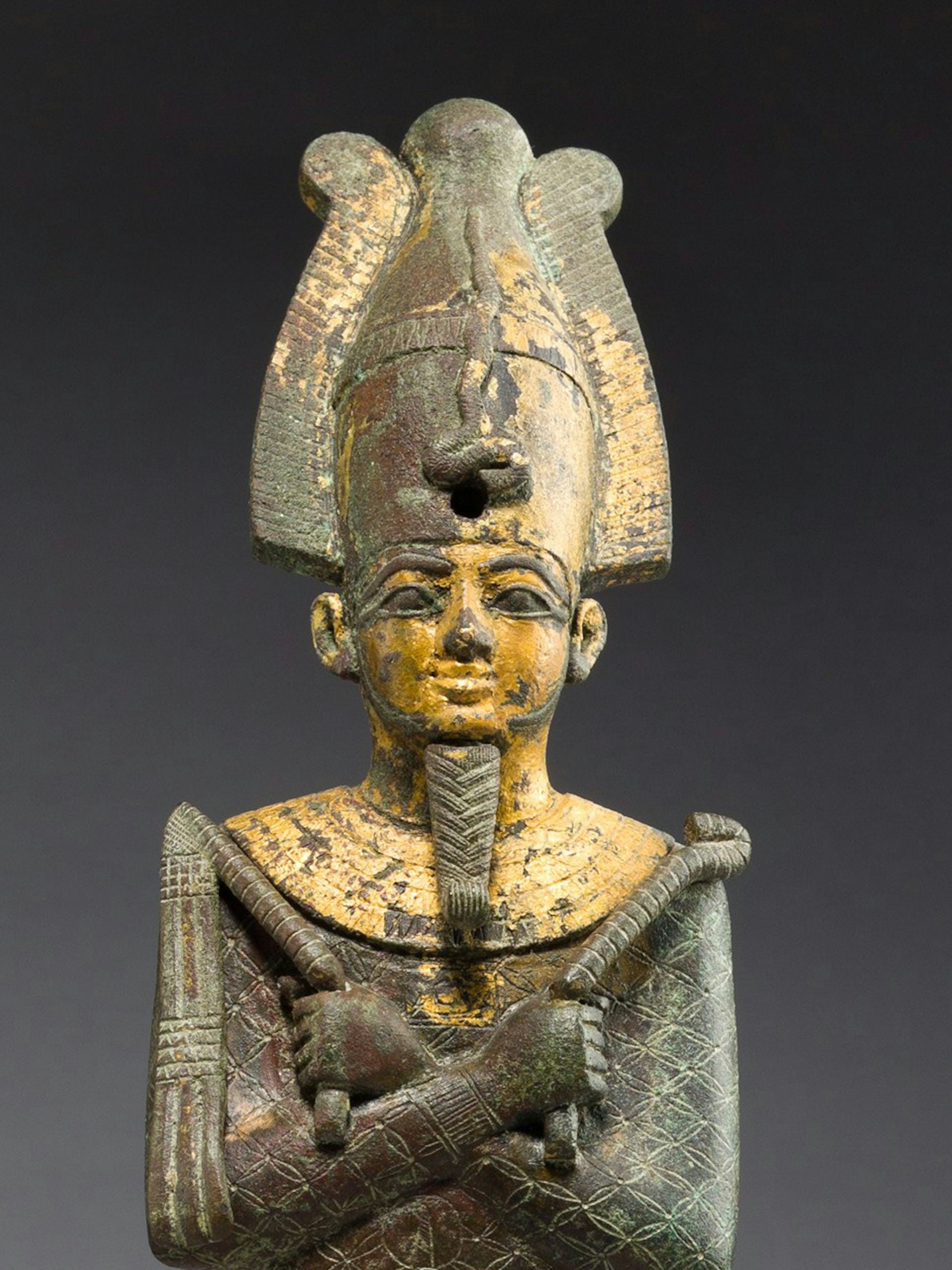
Osiris? Who he?
Frazer tells us that only Plutarch told the Osiris story in “connected form” whose “narrative has been confirmed and to some extend amplified in modern times by the evidence of monuments.”3 Osiris was a creator, and his brother Set was jealous of him, so Set beheaded Osiris and chopped his body up into pieces. Osiris’s sister, Isis, (and wife: yea: they were different back then) went to the ends of the earth to find the missing pieces and reassemble her god-husband-brother. She found all the parts except his penis. Osiris’s penis: was it a McGuffin? Answer in the comments. Anyway…
Among the career highlights of Osiris’s life as a god was: he reclaimed the Egyptians from savagery and taught them to worship the gods and gave ‘em laws. Yea, the big-time God-stuff. Why were the Egyptians savages before Osiris happened on the scene? Simple: they had been cannibals. He also discovered wheat and barley growing wild, picked fruit, and showed Egyptians how to train the vines: he basically gave ‘em beer and wine. He set out to spread the knowledge and if there were climates hostile to vineyards and wine, he made sure the locals got into brewing suds.4 It is at this point you tend to forget about his marriage to his sister and start really giving the stink-eye to Set. Osiris was so beloved by all the peoples of the Earth he returned to Egypt with untold wealth and was worshipped as a god until Set (with 72 accomplices, btw) had him whacked.
We can find innumerable Osiris stories, but we’re still wondering, hey Sir James Frazer: why was Osiris a “black god”? ‘Cuz Egypt is in Africa? That seems too prosaic; there’s gotta be a better story behind this. What do the Rites of Eleusis have to do with this?5
Osiris takes up a ton of mythical space, so cut to the chase: he’s the god of the underworld and symbolizes vegetation (he was worshipped for millennia when the Nile flooded the fields during the Dog Days, around July 23), and death and rebirth. He was a precursor to the Jewish guy who overturned the tables of the moneylenders.
“I Gather the Limbs of Osiris”
This reminded me of Mad Uncle Ezra Pound’s 1911-1912 essay on his new form of reading and criticism, “I Gather the Limbs of Osiris,” his method of “luminous detail” and the essential thing in a poet, that “he build us his world.” Ez’s role, as he saw it, just before Gavrilo Princep got a bead on the Archduke, was likened thus:
If a man owned mines in South Africa, he would know that his labourers dug up a good deal of mud and an occasional jewel, looking rather like the mud about it. If he shipped all the mud and uncut stones northward and dumped them in one heap on the shore of Iceland, in some inaccessible spot, we should not consider him commercially sound. In my own department of scholarship I should say the operations are rather of this complexion. There are many fine things discovered, edited, and buried.6
It’s Ez’s job to find the really good stuff - the jewels - for us. And then he teaches us how to do it ourselves. This is like unto going to the ends of the Earth to find Osiris’s body parts, not to mention teaching us all how to brew or become vintners. Ez would play Isis here, not the first, and hardly the last time he has spiritual dalliances with goddesses. It’s a new method of scholarship and a lot of it is related to translation, but it’s complicated. He’s like the cool English prof who took over the class at the last minute ‘cuz someone needed a sabbatical due to what was then called a “nervous breakdown”; the syllabus said you’d have to read Pilgrim’s Progress this semester, but Prof Pound makes a cutting remark about Bunyan and gives you Chaucer and Ovid instead…and he’s funny, too. (Just ignore those little rants about bankers and usury! By the way: does the Department Head know?)7
The Beast
In the same year Pound began writing about gathering the limbs of Osiris, Aleister Crowley published The Vision and the Voice, about his experience with Dee and Kelley’s Enochian Keys, in Mexico, and then in the desert in Algeria, with Victor Neuberg. When I read this, the magickal experience seems so profound I, after all these years, can’t comprehend it. I don’t feel like I can wrap my head around it. Listen to this, from November 30, 1909, 10-11:45 PM, in the Sahara, Bou Sada:
And we are standing, as if crucified, face to face, our hands and lips and breasts and knees and feet together, and her eyes pierce into my eyes like whirling shafts of steel, so that I fall backwards headlong through the Aethyr - and there is a sudden and tremendous shout absolutely stunning cold and brutal: Osiris was a black god! And the Aethyr claps its hands, greater than the peal of a thousand mighty thunders. I am back.8
The Beast seems to have been influenced by Andrew Marvell and Katherine Mansfield in poetry, by no one else in experience. Haunted by death and violence from his childhood to the date of this absolutely profound series of experiences in the desert, this was when Crowley saw Osiris’s reign as the age of patriarchy, and he wanted to end it. He saw himself as Osiris’s begotten son, Horus, the child, as the dawning of a New Age. Crowley was Horus. There is a footnote to this exclamation about Osiris by Crowley:
The attainment of of the Grade of Magister Templi involves the Annihilation of the aspirant. “Osiris was a black god!”; i.e, of the nature of Binah — BLACK. The love of Binah is that of the Queen Scorpion who devours her mate.9
Where is the origin of “Osiris was a black god!”?
Osiris: Dying, Resurrecting, Erecting: Finnegans Wake
Gonna tryna not get too much in the weeds here, especially after Crowley’s language, but hey, I gotta. Because Osiris died and came back to life, like Tim Finnegan and sooo many other gods, including the Christ (who was a late-comer to the die-rebirth game, actually), of course Osiris is always showing up in Finnegans Wake. As I practice FW bibliomancy on the regular without lusting after results, I’m always on the lookout for Osiris, even in places where it’s not “obvious”10 And around 70 days ago I was rooting around in an early passage:
Hurrah, there is but young gleve for the owl globe wheels in view which is tautaulogically the same thing. Well, Him a being so on the flounder of his bulk like an overgrown babeling, let wee peep, see, at Hom, well, see peegee ought he ought, platterplate.11
And then Joyce inserted the capital E sigla, lying on its back here, after “platterplate.”I see this E on its back (three legs up in the air) as Jung’s collective unconscious within the text. And this is on a page where, mourners are looking at the “dead” hod carrier Finnegan: “Orra, whyi deedye die? Of a tryin thirstay mournin?” How sad that Tim is dead! “Twas he was the dacent gaylabouring youth.” The mourners surround the body with themselves, and enough alcohol to fuel the entire Army-Navy game, and one of the most sodden lines (to me) in all literature:
Tee the tootal of the fluid hang the twoddle of the fuddled, O!
Something about this passage sparked my intuition: is Osiris here? It doesn’t look like it. There’s a dead god about to come back (wake), but I see no Osiris here, starting with “Hurrah… platterplate.” My trusty McHugh12 doesn’t see it either. He actually sees “young gleve for the owl globe” as Islamic: there is only one God for the whole world, etc. I see “young gleve” as one young French man-at-arms holding down this raucous wake. And the whole world is watching (wheels in view), the wheels of the casket screech “tee tee” which is “tautaulogically” the same thing: tau is the 19th letter of the Greek allforabit…err…alphabet. We are all looking at Tim Finnegan/the dead god who will soon rise again. He’s on his back, like a flounder, an overgrown baby…let us all peep at the dead young man.
Then: “see peegee ought he ought, platterplate.”
WTactualF? I have always said to myself “maybe later” with this one. Platterplate was a lotta swings and misses. McHugh seems lost here, too, so I feel cool with not sweating it out. “He” is the fifth letter of the Hebrew alphabet. “Ought” might have to do with “aught” or zeroes? But…where is this getting me and all of us, attending the Wake? Then I found an old exegete, 50 years to the year: Apparently a Wakean named Mark L. Troy, in his dissertation, Mummeries of Resurrection: The Cycle of Osiris in Finnegans Wake (1976), links this to a 1911 (there’s that year again!) book Rois et Dieux l’Egypte, by Moret, capitalizing on the then-recent finding of King Tut’s tomb: on page 88 (“see peegee ought he ought”) there’s a photographic plate (platter) in the book of Osiris being roused by Isis! Recall: Osiris was the god of renewal and agricultural fecundity, so an erection seems totally apt, even if the wife-goddess is dressed up as a bird. (An “owl”?) So Joyce was referring to a page in a 1911 book in French on Egyptian gods. Further, Troy has, “The image of Osiris’s literal erection from the dead, effected by Isis in the shape of a bird…is central to the cycle of Osiris.”13
Gettin’ it straight: we're all looking down at Bygmyster Finnegan in his (wheeled?) casket and he’s got a hard-on. Just to be clear: in this gloss Tim/Osiris is tumescent, a rising before he actually rises…just, in ya know, maybe a Jungian unconscious sense?
So: I now see Osiris on p.6, too. He’s in very many other places in FW, of course.
And yet: I still haven’t traced this origin. My reading fails me, again. And yet, this is the kind of Quest that gives me the kinda thrill that I really wonder about. That you are reading this sentence makes me feel a tad less…eccentric?
RAW on “Osiris Is A Black God!”
Q: Can you explain what Sirius is?
RAW: Sirius is a double star. Sirius A is the brightest star in the sky. You could find it by looking down the belt of Orion. It’s the brightest star that the Belt of Orion points to, the brightest star in the southern sky. Sirius B is invisible to the naked eye and wasn’t discovered by telescope until a few decades ago. It wasn’t successfully photographed until 1970.

The odd thing about Sirius B, which Temple14 documents in his book, is that there are unambiguous, no-doubt-about-it references to it in the mythology of several African tribes. He has demonstrated by inference, and I think correctly, that the Egyptians knew about Sirius B too. He believes that Isis was the symbol of Sirius A and Osiris of Sirius B, and that’s the meaning of the old secret of the Eleusinian mysteries: Osiris is a black god. Sirius B is a dark star, a collapsed white dwarf which is in the process of evolving into a black hole.
Q: What do you think is the significance of Sirius?
RAW: It could well be a red herring. It could be our own minds developing and we need to have some kind of entity that we can project all this on to. It could be that there are no allies, no holy guardian angels, no extra-terrestrials at Sirius. But, there’s a whole chain of amazing coincidences. A guy I know names Neal Wilgus who’s done another book on the Illuminati which is coming out soon, said that while he was researching it he couldn’t go into a bookstore without picking up a book and opening it at a page which referred to the Illuminati. That happened to Shea and myself when we were writing Illuminatus! Once I got into the Sirius thing it kept happening. I went into a bookstore and looked at a book by J.G. Bennett called Gurdjieff: Making a New World. I opened it at random and found this passage where Gurdjieff talks about the hidden references to Sirius in Beelzebub’s Tales To His Grandson. I said, “What! Gurdjieff is making references to Sirius — why?” Then I found hidden references that Kenneth Grant talks about in Crowley’s work. There it seems much more synchronicities. Grant says that Crowley was in contact with extraterrestrials and that Sirius was the Silver Star that’s referenced to a lot in Crowley’s poetry., the Argentum Astrum. Albert Pike, who was a thirty-third degree Mason and was the highest ranking Mason in the United States in the nineteenth century, says in Dogma and Ritual in Freemasonry that the silver star of every Masonic lodge is Sirius. He doesn’t explain why. I kept running into things like that and the communications got stronger and stronger. I tried experimentally entering other belief systems. I decided to take the most far-out belief system I could pick up, which was that fairy people actually exist. As nobody believes in fairies anymore — it’s funny you kept pointing out James Barrie’s place this morning — they’ve got to get in touch with us some way. So nowadays they’re pretending to be extraterrestrials. I entered that belief system, took some acid and went to a witches sabbat…15
Models For Model Agnostics
Sirius being the brightest star in the heavens, of course people would project and speculate about it for the last 5000 years. Then people talk to each other about what things mean, and these ideas morph and get passed along down through the ages.
Lore accretes and the poets with the most active imagination create “reality.” Sirius would be no exception here. “Osiris is a black god!” as a very old meme?
There has been actual contact by (disembodied?) intelligences from some entities within our own podunk Milky Way galaxy. Maybe only the dreamy types are receptive.
This is all a long, drawn-out, ongoing artist’s conspiracy. Andre Breton writes about Sirius being a black god in his wartime Arcane 17, published in 1945…which doesn’t explain 1909-1911 stuff, but I’m sure you can work it all out. The composer Karlheinz Stockhausen had some sort of contact with Sirius, and we could really go down a road with names here, and I’d like to just mention one in passing: Harry Smith, folklorist, ethnographer, musicologist, visual artist….Carl Sagan is debunkingly positive-sure the Dogon people of Africa heard about Sirius B from Europeans, etc. (See Brocas’ Brain, ch. 6, “White Dwarfs and LittleGreen Men,”pp.66-80) In a book titled Sexual Symbolism, which contains “A Discourse on the Worship of Priapus,” Richard Payne Knight writes that Egyptians called upon Osiris as the being who dwelt concealed in the embraces of the sun, and that Osiris represents the male life-giving sexual power/Divine Phallus. The problem is: this book was published in 1786. So you tell me.
I’m sure you can come up with something better than I did!
Illuminatus! omnibus ed, p.123
THIS SPACE LEFT BLANK INTENTIONALLY FOR NATIONAL SECURITY PORPOISES
ibid, p.123. NB: Bugs Bunny, a favorite of the Chicago anarchist Surrealists of the 1960s.
The New Golden Bough (Abridged), revised and edited by Theodore Gaster, an old Mentor edition ppbk, mottled edges, disintegrating acidy pulp paper, p.384. The original Golden Bough, unabridged, by Sir James Frazer took up the entire top of your shelf, ya know, the shelf above all your BDSM and psychoactive drugs books? Or rather: it would have. I still find it difficult to fathom how much Frazer’s work fueled the imaginations of every type of intellectual in the late 19th/early 20th century. Deservedly so, I say. Aye. ‘Tis.
Yea, I know: quite the hero! Here’s how Ishmael Reed unpacks some of this: “Set wanted to use the death of their father as an excuse for invading foreign countries. Set hated agriculture and nature which he saw as soiled dirty grimy, etc. He was arrogant jealous egotistical and when Osiris issued a ban on men eating men, introducing the techniques he learned from the long-bearded Black men in the university at Nysa, Set began to plot his brother’s downfall.” - Mumbo Jumbo, chapter 52, p. 185
At this point, I get lost in the abridged Frazer. I lose the plot for a bit, because that info is so interesting, and because I know how influential armchair anthropologist Frazer was on all my favorite writers. While flippin’ around in Frazer, I’m cavorting with my own gods.
Selected Prose, 1909-1965, Pound, p.22. “I Gather the Limbs of Osiris” pp.21-43, in this volume. I find it all fantastically nutty and wonderful.
Here, again, I forget myself and re-re-read Pound’s long essay, ‘cuz it’s a gas, like Jumpin’ Jack Flash. Where does this OG guy find the time? Easy: I got no job and I don’t game. I barely even watch TV, and I certainly ain’t mixed up in all that social media thing, that’s fer derned sure. Now that every article in every issue of the Washington Post constitutes some species of doomscroll, why…
I take this passage from this site. See near the last. One of Crowley’s main biographers, Israel Regardie, wrote that he felt unequal to the task of explaining what was going on here in, not only this vision, but others included in that book. (Eye In The Triangle: An Interpretation of Aleister Crowley, pp.392-396)
Binah: the sephiroth below Kether/The Crown in kabbalah. Separating, making sense of things: Understanding. Crowley’s color correspondence with black here is an ancient one: it represents the absorption of all colors, depth, and the hidden, mysterious potential of understanding.
as if anything constitutes “obviousness” in FW!
Finnegans Wake, p.6, bottom, lines 30 -35 or so.
Annotations to Finnegans Wake, by Roland McHugh, that is. John Bishops’ Joyce’s Book of the Dark has a ton on Osiris in FW, but not a gloss for p.6 that panned out for me.
Robert K. G. Temple, author of The Sirius Mystery (1976); the more recent edition has the full title The Sirius Mystery: New Scientific Evidence of Alien Contact 5000 Years Ago.
from a 1977 interview with a British magazine called Weird Trips.
Thanks for this. I love the way in which we all burrow into our own rabbit holes while trying to explore thIs stuff. I remember going deep into Harvey and Bugs (speaking of rabbit holes) and ending up at The Lady if the Hare by John Layard.
Another place the Wake sent me was back to Phil Farmer’s Riverworld series, which I am convinced couldn't have been written without the Wake, beyond just the resurrection theme.
I find it interesting that "AI Overview" on Internet does not mention Osiris's genitalia. According to AI Osiris was "incomplete"! "Because he was incomplete, Osiris did not return to the land of the living"
Also, there is a science fiction movie named Osiris (2025) - A team of special forces commandos wakes up on an alien spacecraft with no memory of how they arrived. They soon find themselves in a fight for survival against bloodthirsty creatures that use humans as livestock.