Radio Days
A life listening to radio and the erotics of disembodied voices

Radio has had its day in the sun and is passé, culturally, but it feels omnipresent in my life, a taken-for-granted medium that, when I actually think about it, has had a profound influence on my life. I still listen. Here I will merely glance at some aspects of radio, my own life as a radio listener (“user” in Internet parlance), and my own idiosyncracies with regard to these waves.
1. Time and Place
I grew up in the San Gabriel Valley area of Los Angeles County and came of age in the 1970s. Of course radio was a Different Animal then, for many reasons, but if only one: there was no Internet. I recall walking to class at Citrus College and a friend was telling me about the idea of Internet, though it didn’t have that name. This would have been around 1988. We would all have our own computers! And they’d be connected with each other and he had all this insider knowledge and it just seemed kinda ridiculous to me, but a cool idea. And he went on and I just responded with something like, “Do you ever read anything outside of science fiction?”
The radio was the auditory wallpaper of our lives, me and my friends. There would be certain stations (93-KHJ) and it was all about music. AM pop radio format. Top 40. Amplitude Modulation. Somehow you would just always be familiar with the latest hits without ever really paying attention to them. They just were. They were played, over and over and we knew them through a kind of electromagnetic spectrum osmosis. This music was given and we accepted it and it became embedded with our memories of incidents while doing what I’ll whimsically call “growing up.” By and large, we were adolescents so therefore we had “our” music, which was required to be NOT our parents’ music. The process of individuation: millions of teenagers all asserting their individuality, listening to the same rock bands and buying the same records. At some point we noted that some of us would make remarks about the aesthetics of some song or band. This was a new kind of talk. Then there were (dis) agreements and some inchoate ideas about “taste.” I think notions about taste came from comparing one thing to another. How surprisingly difficult it suddenly seemed to make the slam-dunk case that one band or act was “better” than another. It was subjective, but we thought there was something wrong and all this must be objective. The Raspberries were cool, but the Beatles were still objectively better. But some guy said “Go All The Way”1 was better. This was confusing. We were 13. Of course!
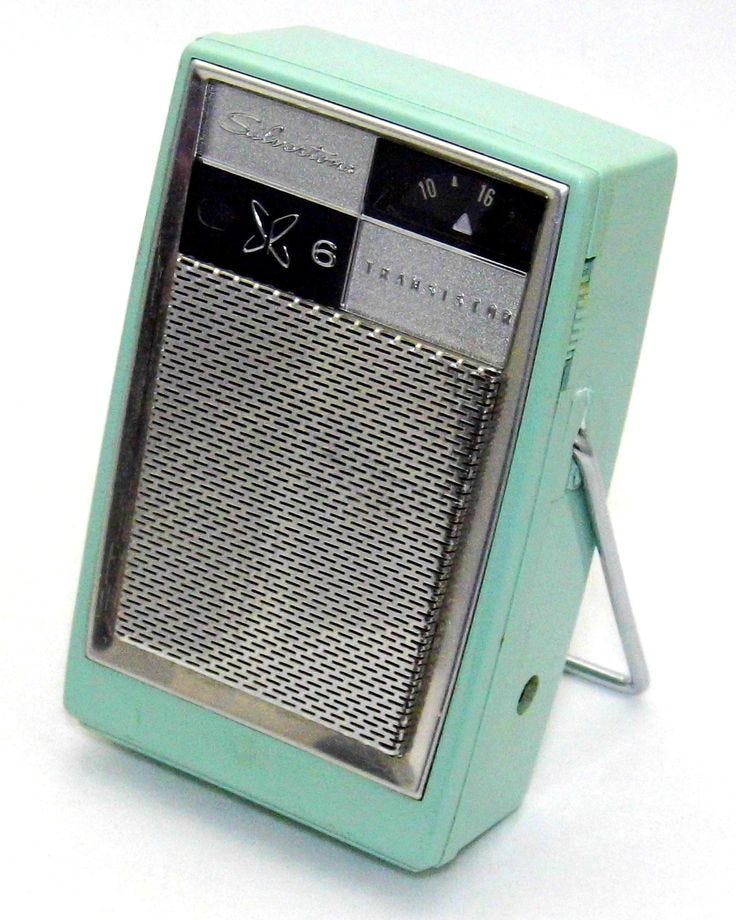
(my first transistor radio looked a bit like this, but the edges were rounded)
2. Gary Owens, Wolfman Jack, The Real Don Steele, etc.
At some point you note there are talkers amid the music, and they did things with their voices. They talked with some hipster patois that wasn’t local to our native area, so was exotic and interesting. Some spoke really fast. Some just had these trippy aspects to their voice that…you couldn’t put your finger on it…why does this person sound so interesting when they’re only announcing the time and call number of the station? Were they born that way? Did they do some sort of yoga to get their voice to sound that intricate, nuanced, strange, resonant, bassy, funny? I never lost my fascination with these voices. With some of these voices, as I got older, I found out all kinds of new things about them. As a kid, I took Gary Owens as he was: very funny and his voice was amazing. As I got older, I realized he was part of this much older conspiracy of “hip”pop surrealism.2 It suggested…(cough) psychedelic drugs, or maybe that “pot” stuff, but who knew?
3. I discover Frequency Modulation
I’m maybe 14. A friend from down the street shows me how to manipulated a knob on my mom’s old Magnavox console stereo (it had wheels and a separate compartment to store vinyl LPs) and suddenly everything changed. This was FM. In my memory, the effect of FM was like that first time you watched The Wizard of Oz and it goes from black and white to color. FM was color. How would I ever be able to go back to AM after this? It was like my first kiss. It was either KLOS-FM or KMET-FM, Los Angeles. Everything about it was a new world. The Allman Brothers, Queen, Aerosmith, Rolling Stones. I had heard these bands on AM, but I now realized they were made for FM. I had heard Pink Floyd’s “Money” on AM Top 40 - they cut it to make it shorter? - but now here’s “Breathe…breathe in the air/Don’t be afraid to care…” Oh my frikkin’ gawd!
Then, the FM deejays: this was some secret world of underground cool people! How did I not know this? They did NOT sound like Gary Owens, The Real Don Steele or Wolfman Jack. They all sounded like they had the best hashish delivered to them by exotic swarthy females. They probably used an elaborate and ornate hookah to smoke it, too. Yep: they got high on hash from a hookah just as soon as they put on “Street Fightin’ Man” or “Whipping Post” then resumed their reading of William Blake or Philip K. Dick. Although they never said anything about it, no doubt they had been against the Vietnam War, probably since 1965. These were The Cool People. In LA suburbia, this was momentous for me.
‘Twas what he’s doin’ this Marshall McLuhan: “If we sit and talk in a dark room, words suddenly acquire new meanings and different textures…” “Radio, once a form of group listening that emptied churches, has reverted to private and individual uses since TV. The teenager withdraws from the TV group to his private radio.”3
4. WTF is Radio, Anyway?
Well, some extraterrestrial named Nikola Tesla seems to have, like Prometheus giving Fire to mankind, bestowed the capture of electro-magnetic waves, upon us. And it was good. Sure, the history is muddled. Marconi was there and did his part. Before them Heinrich Hertz conclusively proved James Clerk Maxwell’s prediction of invisible waves of energy that could possibly do things. The idea of “mental radio” which was basically the same as ESP or telepathy, was widely considered, even believed. Upton Sinclair’s wife was supposedly psychic and he wrote a book titled Mental Radio that Einstein liked, and Einstein wrote an introduction for the German version.4 Before 1920 or so, radio was a fascination for physicists, amateur tinkerers, and dreamers imagining the occult forces of “wireless telegraphy.”
I loved this bit from poet Ander Monson: "Like Cocteau's Orpheus we tune our radios low and wait for communication. When it was new the radio must have seemed like magic: from apparent nothingness, a voice, a song, deliverance. It seemed that way to me in cars at night driving through snowstorms, heading home, hoping to pick something up to give the transitory hour some meaning. Through its lighted dials I can understand how some believe in spirits, ghosts, faeries, God or something else: if we can communicate through air, who's to say there's nothing else?"5
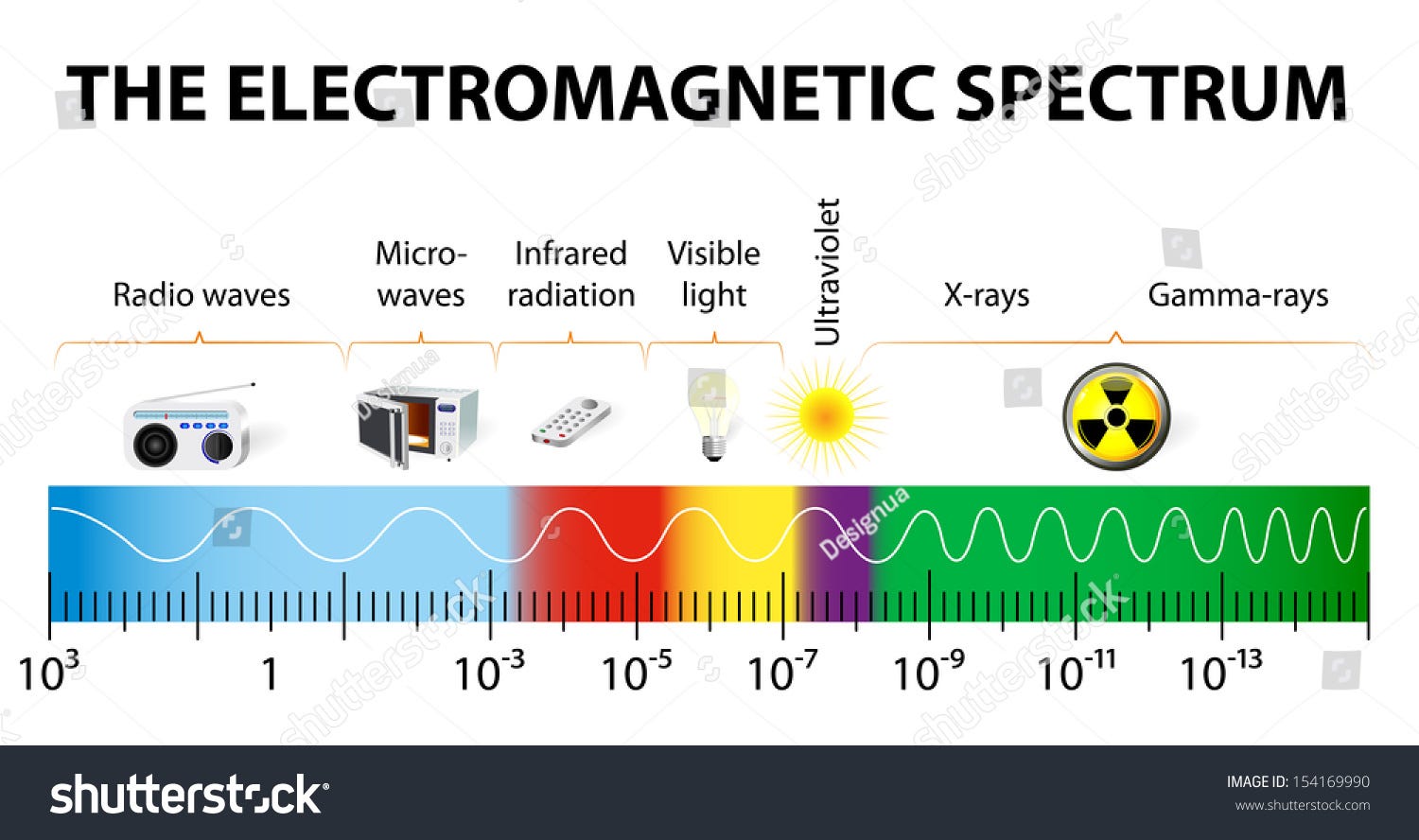
“Visible light” here seems so lost in the crowd. Like Copernicus: we’re orbiting the sun, not vice-versa. Like Darwin: we evolved from ape ancestors. Like Hubble: our galaxy is just one of trillions. How narrow the band of visible light! How do you negotiate this? Hey I kinda like the puny humility of it all: we need to get off our high horses, some much more than others, of course…
5. The 9-volt AM-Only Radio
I think my alcoholic, troubled grandpa gave me my first transistor radio, a tiny hand-held off-green-plastic one that ran on a 9-volt battery. On school nights I’d listen to the Lakers and Chick Hearn or Vin Scully call Dodger games. These were endless summers and winters, timeless autumns and springtimes. Hearn and Scully were intimates (with lil old me!) and had an embarrassingly profound impact on my own powers of description. They painted pictures of these remote games in my mind, and having seen an adequate number of examples both live and on TV, I knew how to “make” those pictures vivid. At night I simply put the radio under my pillow and didn’t bother anybody, and retreated into the world of radio and my teams, then dreams.
I remember a Dodger game ending, then the post-game report, then some ads, then Scully signed off, told us the score of the game and when the next one was happening, and then…the Frost Report. Or maybe those were only after Lakers games, in the Winter and early Spring. Anyway…I grew up in a town in the San Gabriel Valley that was once the largest packer of citrus in the world. Or something like that. The town was all orange groves at one point. You see something very much like it in the scene in Chinatown, when Jakes Gittes (Jack Nicholson) looks for where the stolen water was going and some rednecks rough him up, but he gets in his licks, too. The Union-Pacific ran through, taking our oranges all over the world, or so I was told. By the 1970s, the groves had mostly been removed for tract housing, but I remember a grove in the middle of tract housing one block up from us. The Frost Report sounded local, and jarring after hearing Scully or Hearn, like a telephone call from some official. Then the station that carried the baseball games, KFI-640 (50,000 watts) played music that I didn’t dig, so I turned to all-night radio call-in talk show, KABC-790. There were weird adults who were very opinionated and I got ideas about differences in politics and what an issue was. I vividly recall Ira Fistell, who was the first “know it all” guy I ever heard. A lot of the time a listener called in and wanted to show Ira they were smart too. Ira seemed tolerant. Ray Briem sounded smart too, but I got the feeling he wouldn’t approve of my very long hair. I was 12 or 13.
6. Glomming Onto the Erotics of the Speaking Human Voice
Just today I wrote a fan letter to a local radio station, extolling the brassy healthy big sexy voice of an afternoon deejay at a local station. “Please tell her I love her voice!”, was the basic message. My life with radio made me increasingly aware of the sounds of voices. I’ve found that voices can be extremely trippy, and they activate something endogenously and mildly cannabinoidal in me. My own voice is airy, sort of high-pitched and nothing to be on the radio about. But every now and then some ordinary citizen will say something and I not only take in the content of what was said, but I might think, “Possibly a radio voice.” What causes a radio voice? I suspect all the things that produce speech: lung capacity, structure of the throat (especially folds in the larynx) and mouth and sinuses, overall body-type, an attention to phonetic phenomena, and so much more. Those who study nonverbal communication have ascertained that only 10% of what we actually say is part of the message we’re sending. Quite a lot is eye contact, body language, how far away you are from someone, appearance, whether there’s any touching or objects involved in any way, and then there’s my obsession: the “paralingual” aspect of prosody: that’s what I’m talking about here. Apart from what is said meaning-wise, there’s the sounds of voices. Darwin was also interested in this.
There’s a fine writer named Sarah Vowel who’s also done cartoon voices. Similarly, to me, is longtime NPR “Fresh Air” host Terry Gross. These are just two females with remarkable voices. To me. There are many others. So, for me, a voice can be of any kind, but of all these kinds there are types, and I make my own typifications and then assess: this voice here is a really good type of this sort of style of voice. What I want is something far outside of “normal” (whatever that is), and better. I recently found out that the classical music DJ at WQXR in New York, Jeff Spurgeon, is retiring in September after 50 years of radio. He has a “Voice of God” type voice for me, and I’m going to miss him.
I remember having a conversation with an intellectual when I worked in a library in Palos Verdes. He was going on about Freya Stark, who I confessed I’d never heard of. He was beside himself that I didn’t know who Freya Stark was. So he told me, and later I read up on her: she traveled amongst the Arabs in the desert, one of the first non-Muslims, and a female to boot. She broadcasted over the BBC and was said to have the “voice that breathed over Eden” about her.6
I’ve long wondered about the deceptive qualities of great voices. Research has shown that charismatic speakers have the ability to alter the frequency of tones in their voice, an unnervingly strong influence that I file away as part of rhetoric.7 In The Age of Faith, Will Durant reports that one description of the Prophet Mohammed was that his “voice was hypnotically musical.”8 I find this all very bothersome in its implications.
7. Katherine Dunn, Novelist and Radio Personality
Dunn, a personality linked to Portland, was the author of the cult novel Geek Love, and was also a radio personality with a remarkable radio voice. Her own thinking about voices shows up in many places in that unforgettable novel. Here are some passages from the novel:
"Dr. Phyllis should have had a nice voice. It was cool and high and always controlled. She never ran off into the ragged edges of sharp like Lil or Iphy. But it still wasn't pleasant. It was monotonous as a sleepwalker. Her words came out cleanly, nipped off surgically with a slightly heavy breath where an r should be. She spoke Lil's old tongue, the long, smooth one from the right side of of the hill in Boston. Though, when Lil asked her, Dr. Phyllis said she'd never been there." (p.128)
Here’s the voice of the main character, Olympia, an albino hunchback dwarf, who has a radio show just like Dunn. This, I take it, is about Dunn herself:
"But my voice can take me anywhere. I can be manicured silk receptionist, a bureaucrat of impenetrable authority, or an old college chum named Beth. I can be a pollster doing a survey of management techniques or a reporter for the daily paper doing a feature on how employees view their bosses." (p.150)
The sideshow family member “Arty”, a grotesque manipulative mean-spirited man-boy with no arms or legs but who started a successful and lurid religious cult with himself as the leader had a plan to manipulate the attendees of his Aqua Boy “show” with an electric current that ran into the seats, so that whatever he said to them, they would feel it and make him even more persuasive. He’s pitched this idea by an electrician that travels with the freak show:
"Sound is a vibration. It carries through matter. When you hear, it's not just with your ears. A sound actually affects every cell in your body, making it vibrate and pass that information to all your other cells. That's why they say a sound is 'piercing' or a scream 'goes right through you.' It does. It actually does. [...] "I was thinking, what if your voice wasn't just coming at 'em from the air but was vibrating up from the soles of their feet through their asses up their spines. I was thinking what it would be like if they felt what you had to say because the boards they were standing and sitting on were wired to carry the vibrations of your voice." (pp.174-175)
Olympia is talking with an Irish barkeep in Portland:
"You've a voice like mulled toddy, Miss O," grins Jimmy. "I cried like a busted banker at your story on the radio this morning." "Hush," grunts Oly, ducking. A peek into the empty darkness behind her. "The Story Lady at Station KBNK isn't supposed to be boozing at 10 A.M. Today's show was an old tape. I called in sick. Besides, McLarnin, I have the voice of a baritone kazoo and your real name is Nelson. You were born in Nebraska. Admit it." (p.343)
Here Olympia “sounds” like a voice out of Joyce, and indeed, Dunn moved to Dublin the 1970s before returning to Oregon. Rarely does a writer think as much about the effects of the speaking voice on an audience, and no wonder Dunn was obsessed with her voice. And others’.
8. The Spellbinding Voice of Terence McKenna
I first heard McKenna before I ever read anything by him. Pacifica radio station KPFK in LA played talks by him after midnight on “Something’s Happening”, hosted by Roy Tuckman, AKA “Roy of Hollywood”, from midnight to 6 AM. When I first heard McKenna I knew nothing about him, but was absolutely floored by his idiolect, his diction, his subject matter: psychedelic drugs, esoterica, and the effects of books and how ideas melded into one another. But it was his voice. If you’ve heard you know. Here’s a passage I liked from his brother’s book about his life with Terence, where they lived in a three-story communal house on Telegraph in Berkeley during the Summer of Love:
“The house was the epicenter of an eclectic scene of wild-eyed freaks, dealers, travelers, and other other characters in the Bay Area looking for fun, sex, drugs, and whatever else was to be had. Crashing in an open room, Tom and I were up for all that and more. Terence fit right into this scene. His room had become a sort of informal salon where people would show up to get loaded and stay to hear him rant. And he always had something to rant about. Unlike most people, who get high and grow quiet, cannabis never affected Terence that way; it only made him more articulate, more talkative, and more able to weave his enraptured narratives. He often had a receptive audience of very stoned listeners hardly able to speak or move while he regaled them. He was in his element, and he loved it. That may have been when Terence first realized he had the gift of gab, in spades. People just loved to hear him talk; he could keep a group seated on the floor of his bedroom spellbound for hours. It didn’t really matter what he said — it was the way he said it. Much later in his life when Terence started to address larger groups in more structured venues, he found the old magic still worked, a talent he eventually leveraged into his public career.”9
9. Americans Exposed to Regional Dialects From all Over Their Own Country: Radio
There’s an amusing fact-anecdote from Murray Kempton, who was covering the 1992 Presidential National Conventions. In 1932 Americans heard actors in movies putting on an accent every now and then, and voice actors on radio faked accents too, of course. But the 1932 conventions for POTUS were covered on radio, and Americans could finally hear all sorts of regional accents:
"Sixty years ago the miracle of bringing the conventions alive for untraveled Americans was the work of the radio alone, and it did that office more than handsomely, by reducing commentary to a minimum and leaving the tale to be told by the delegates in a jumble of regional accents and regional prejudices conjuring up the image of a vast continent of exotic provinces, each with its own language."10
To think this was less than 100 years ago!
10. Prosody and the Polyvagal: Porges
Dr. Stephen Porges has had some intriguing ideas about the vagus nerve, which has become a hotbed of research since he started to make much ado about that nerve in us. From what I can tell, much of his hypotheses and theories have taken a hit in recent years, but he really helped to get the ball rollin’…and what of this mysterious effect (or affect!) regarding the musical and hypnotic qualities of human speech called prosody and the vagus nerve?. His notion:
“Prosody is the intonation in voice that conveys emotion. Polyvagal Theory emphasizes that prosody is mediated by vagal mechanisms and, similar to heart rate variability (i.e, respiratory sinus arrhythmia), conveys information about physiological state.”11 Further: “When we listen to intonation - prosodic features of voice - we are reading the other person’s physiological state. If the physiological state is calm, it is reflected in a melodic voice, and listening to that voice calms us down. Another way of thinking about the relation of vocalization and listening is to understand that long before there was syntax or language in mammals, there were vocalizations, and vocalizations were an important component of social interaction. Vocalizations convey to conspecifics - members of the same species - whether that individual is dangerous or safe to come close to.”
Here is a theory about why I’m drawn to certain voices. Prosodic mediations via the vagus nerve about physiological states. A quick question comes up: what about detecting bogus “calm” and “safe” speakers? Can we detect those? How easy is it to fake these states? I need to do more research, but this seems like a good working hypothesis for me. Wilhelm Reich had some thoughts about how “character armor” affects speech via unconscious muscular constriction in the throat. “Reich retained an earlier interest in character analysis in the tone of voice. He noted that with armor in the throat, the voice is ‘usually low, monstrous, ‘thin’…In this condition, one will try in vain to talk with a loud and resonant voice. Children acquire such conditions at a very early age, when they are forced to suppress violent emotions to cry.’”12
11. Late Night Radio DJ Gives Women Listeners Orgasms
I ran into this while reading about the history of overnight radio in American life:
"There's no doubt in my mind that all-night listeners establish a greater intimacy with the host. In fact, in my case, maybe I allowed too much intimacy. I've thought about this a lot. Being on the air 5 hours a night kind of inspires a greater closeness with the listening audience. I couldn't keep secrets. If something had happened, it came spilling out of me. So maybe I was a bit too open. I was so open with the audience that it felt it could be open with me, so there was certainly something of value to be gained. No one could argue that all-night radio doesn't contribute something of real value to American life. It comforts a lot of people who really need comfort - people who have either a temporary or permanent emotional problem, people going through divorce, people in prison, people who are ailing, and people of who have chronic sleep disorders, to name a few. It makes a connection with people that television and other media can't. All-night radio contributes a lot. If it causes somebody not to give up the ghost and go grab a gun and start shooting people, it's done plenty. Let me take this in a slightly different, if not perverted, direction. Talk about all-night radio being intimate, when I did that shift there were women who called and told me they had orgasms while listening. Some were upset because they were afraid they were being unfaithful to their mates. Did I like doing all-night radio? How can you not like being the guy who gave orgasms all night long on a 50,000 watt clear channel radio station?"13
This was uttered by longtime East Coast DJ Dick Summer, and while sorta braggy and possibly apocryphal, I think it’s on to something.
12. How to Enhance Your Enjoyment of Human Speech? Cannabis:
My colleague Sebastian Marincolo quotes from High Culture: Marijuana in the Lives of Americans, by William Novak:
“After a joint or two, I find myself paying more attention to what the other person is saying, rather than only hearing the words he uses in trying to get his point across. By keeping track of his mannerisms and his tone of voice in a more concentrated way than usual, I can more fully understand his point, and can respond more directly than normal.”
Marincolo links this to cannabis and hyper-focusing: “A shift of our attention to a stronger focus on body language and the ‘tone’ of a statement certainly may help us to understand others better. This is why dogs understand us so well, why they feel our sadness, joy, or pain, without being able to understand our language.”14
When listening to the radio as kid, I had no idea about any of this, of course. But I intuited quite a lot of it. Voices on the radio know they’re acting, know they’re putting on a show, are aware that their speech qualities ought to have some aspect of magic in their utterances. So what’s left is the unbidden effects of a voice. At least for me. And listening to voices will never get old. These auditory displays are everywhere we go, so let us cultivate our appreciation of them. There seems to be some sort of quality…
Here’s The Raspberries doing a lip-sync of their hit “Go All The Way.” 1972. As I got older, I realized they were very many bands who rode the coattails of the Beatles, and I thought The Raspberries were just trying to be Beatles with a hard-rock vibe. The bridge part of “C’mon/I need ya/I love ya!” is very Beatles, as is when they go to the relative minor of A major, F# minor, with the falling chromatic bass line in the guitar part, which jangles like George Harrison. I loved this song just a puberty hit for me. But the Beatles had long burrowed into my musical DNA, never to leave, only to grow.
If you don’t know who Gary Owens is, just check out this bit: Golden Voice Announcers School. My gawd, I love this guy! I did not have $13,000 though, so I missed out. The Real Don Steele sounds here: skip to 13:17. I later realized there were 1000 DJs who sounded like The Real Don Steele…and why was that?
Understanding Media:The Extensions of Man, Marshall McLuhan, chapter 30: “Radio: The Tribal Drum." This epochal book came out in 1964 and made McLuhan an intellectual superstar. Most of it was written in the late 1950s! I’ve since read multiple biographies of him and there’s a lot more behind the curtains with this guy. When he’s wrong, he’s wrong in the very most interesting ways possible. I see reading McLuhan on media as super-valuable because, even when he’s obtuse and swinging and missing, he makes us sensitive to the effects of media in a way that had never happened before. What a profound thinker, aye!
Phenomena: The Secret History of the US Government’s Investigations into Extrasensory Perception and Psychokinesis, Annie Jacobsen, pp.184-185. I think the Wiki for “History of Amateur Radio” is really cool.
Letter To A Future Lover, Ander Monson, p.103
Books: A Memoir, Larry McMurtry, p.157.
Charismatic speakers and larynx folds. This kind of thing would be part of nonverbal communication for me. That rhetoric can be non-verbal was a jolt to realize. It has fostered a sort of hermeneutic of suspicion for me in that I consciously hear a good voice and something in me says to be on the lookout for who this person “really is.” So that’s another dimension of my obsession with voices. Similarly, possibly even more creepy than the well-known aspect of one politician being taller than another and that gives them the edge: the “caveman” aspect of politicians: deep voices subconsciously mean confidence and strength, which seems to outweigh age, experience, and professed values. I was astonished to see Trump win, not only because he was so obviously a grifter and loser but he really didn’t sound good to me at all. So this research is either limited or I can’t hear it. See here on this topic.
Age of Faith, Durant, p.173
Brotherhood of the Screaming Abyss: My Life With Terence McKenna, Dennis McKenna, p.132. There’s a group of people who recorded Terence’s talks and now they’ve spread all over Internet, and if Terence’s talk about the Voynich Manuscript wasn’t the first thing I heard from him, it was one of the first things. It’s HERE.
“Oh, For the Brawls of Yesteryear,” collected in Going Around: Selected Journalism, Murray Kempton, p.405
Pocket Guide to Polyvagal Theory, Dr. Stephen Porges, p. 23 and p.109. I also find it interesting, along these lines, that Ezra Pound thought one aspect of poetic writing was the musical aspect, which he called melopoeia, and that sensitive listeners to poetry or poetic prose written in a language the listener didn’t know could still experience effects that approached meaning. Pound: Literary Essays, p.25
Fury On Earth: A Biography of Wilhelm Reich, Myron Sharaf, p.312. Sharaf’s quoting WR from Character Analysis.
Sounds In The Dark: All Night Radio in American Life, Michael C. Keith, pp.12-13.
Elevated: Cannabis As A Tool For Mind Enhancement, Marincolo, p.131.
Well, this is certainly a post that hits my sweet spot. I have loved listening to the radio all my life, and loved radios, too. When I was young, I made crystal set radios. Now that I am old, I collect them. Some of my favorites are my GE Superadio III, my Tivoli Model One table radio, my Sangean HD radio, my old but still working Admiral table radio which was probably young when I began listening to FM radio in high school in the 1970s. Have you heard that old country song, "There Ain't Nothing Wrong With the Radio" by Aaron Tippin? It speaks truth the way a good country song does. I have driven some real wrecks in my time, but at least the radio always worked!
I listen to my radios at home but also my car radio. I have buttons saved for the local classic rock station, the local alternative rock station, the main sports talk station, the AM station that broadcasts local sports, the local jazz station and the local classical music station. Also the NPR news station, altho I don't listen to it very much, as I already get plenty of bad news from The New York Times, The Washington Post and Reason magazine's website.
It's interesting how listening to the radio can give you a music education. I learned a great deal about rock music via radio. For years, I never felt the need to buy a Led Zeppelin album, I already knew the band's music so well. A few years ago, I sat down and listened to Pink Floyd's "Dark Side of the Moon" album all the way through, possibly for the first time in decades. I was surprised to discover that I knew every song by heart, simply because I had heard each track repeatedly played on FM radio. Listening to classical music radio also has helped me learn a lot.
I liked your bit about Eric Carmen. "Go All the Way" is my favorite Raspberries song. I live in the Cleveland area, where he was from, and when he died a few years ago, there was a sad, bitter court fight between his children and wife No. 3 over his estate. "As I got older, I realized they were very many bands who rode the coattails of the Beatles, and I thought The Raspberries were just trying to be Beatles with a hard-rock vibe." Also not a bad description of Cheap Trick. I have seen Cheap Trick in concert five times: Three times in Oklahoma over the space of quite a few years, once in Dallas at an all-day megaconcert, and once in Cleveland after I moved up here.
I suppose you have heard the story of how the Rolling Stones "rode the coattails" of the Beatles? The Stones were signed by Decca. Supposedly Decca knew the label had screwed up badly by rejecting the Beatles, and label executives took a chance on the Stones because they could not afford to make the same mistake again.
Terrific piece. I had parallel experiences. In eighth grade I listened to a lot of AM radio. They had news once an hour, and listening to this helped me do well in the weekly trivia contests in my social studies class. In the second semester of eighth grade a new student came to the school, Scott Larson. He joined our German class and he and I did not get along. That summer I got super into the Beatles. Our 7-9th grade junior high did not offer third year German, so a few of us walked to the high school next door for our German class every morning. Scott and I got to talking, and it turned out he loved the Beatles too. That December I went to his house for the first time and he place "Money", "Come Together" and "The Ocean" for me, none of which I had ever heard before in my AM world. Changed my life forever. He got me to start listening to FM radio.
In junior high I also listened to old radio shows. I remember "Inner Sanctum" started by telling the listener to put chair in the middle of the room with your back to the radio, turn out the lights, sit down and listen. Great stuff. Stephen King has a nice discussion of radio horror in his non-fiction book "Danse Macabre".
I find it interesting that Orson Welles created perhaps the most influencial radio show and the most influencial movie of all time, both before he turned 26, and he also did revolutionary stage shows.
I moved to Southern California in December 1997. I got a job as a management trainee with Blockbuster Video in February 1998. They had me travelling all over Southern California filling in for sick managers. I would search the radio dial, and on Sundays I kept hearing this great Grateful Dead show hosted by Barry Smolin on KPFK. I had grown up in the Bay Area, so I had a slight affection for the Dead, but his voice and his show made me a Deadhead, and for years I had to hear his opening poetic monologue on Sunday nights. Later I learned to love Smolin's novels.