
I recently happened upon an article1 about the Chinese classic (or favorite), Six Records Of A Life Adrift, by Shen Fu (1763-c. 1803).2 Shen Fu was a dropout scholar who partied and scraped by with his much beloved and devoted (and possibly lesbian?) wife, Chen Yun. He never lost his keen eye for the beauty in simple things. The book was never published in Shen Fu’s life, and we’re not even sure when he died or where he’s buried, The manuscript was found in a secondhand bookstore stall maybe 70 years after Shen Fu died, and there were only four chapters, or “records.” Possibly he never got around to writing the other two chapters, or they, too, were lost, and there have been “found” some versions of the lost chapters, probably of dubious origin. It’s one of contemporary China’s favorite love stories: Shen Fu and Chen Yun. You never know what some of those dusty items in your favorite used bookstores really are until you - or someone else - gives a good look.
Since my teens stories of lost books have fascinated me. There must be many such books out there, now.
Larry McMurtry, a bookstore owner in addition to being a successful novelist, wrote about “the silent migration of books” in his Books: A Memoir. It’s kind of weird how some of his own self-inscribed books from before he was a famous person made their way back into his hands. His discussions with other booksellers yielded similar strange stories of books that found their way “back home”: “I know a collector in Virginia who claims he lost one volume of Douglas Carruthers’s two-volume Unknown Mongolia while traveling in the Gobi Desert, only to reacquire the lost volume several years later at Estate Book Sales in Washington, DC.”3 As I happen upon such anecdotes about books in other books, it taxes my ability to think probabilistically. Some rare, expensive books that have become unaccounted for would seem to travel amid antiquarians, and so a limited number of book-experts, and thus their reappearance would seem not as marvelous as it did on first sight. But others?
Eugenia Zuroski, an English professor at McMaster University had a copy of Consuming Subjects: Women, Shopping and Business in the 18th Century, by Elizabeth Kowaleski-Wallace. She often lent it to students and always got it back. Until she didn’t. One day she went to lend it out and couldn’t find it. I know the feeling: did someone steal it? I probably misplaced it. You search for it for a month or so then come up with some hypothesis about why you can’t find some book you knew you had owned. What happened to it? Who had been in my own private library? Who that would actually steal a book? I could think of no one. My guitar students seemed kinda put off by all the books lining the walls. (I often imagined: “Hey, this guy’s weird, but he’s a good teacher, so…”) After five years, Prof Zuroski simply went to Amazon and picked the cheapest used copy available, from multiple copies being purveyed by used book dealers, and, as you probably guessed, it was her missing copy. She had written her name on the title page. "I had to put it down on the desk and pick it back up to make sure I wasn't hallucinating," she said.4
Has this kinda of thing ever happened to you? No? Okay then, how about a friend-of-a-friend? How many people actually buy these books and then read them? It seems the number is small, but there still seems something unheimlich about this.
I don’t know what the actual F happened here. I can’t explain it. Can you? Aldous Huxley is on his cancer deathbed, on November 22, 1963. His wife Laura did as he had requested: she gave him a massive dose of LSD to help him in transit through the Bardos after bodily death. As Aldous tripped and slipped into thermodynamic equilibrium, Laura read from the Tibetan Book of the Dead, into his ear. Not long after Aldous’s death, Laura engaged the medium Keith Rinehart. She wanted to know if there was a way to “contact” Aldous in the death realm. After some time, Rinehart announced he’d gotten a signal, and that Laura should go into Aldous’s study, where she’d rarely been, and take off of a certain shelf the fifth book and look at page 17, line 23. It was a Spanish language book titled Coloquio de Buenos Aires, a collection of essays on modern writers published by PEN Club of Argentina.
On page 17, line 23, Laura read, “Aldous Huxley does not surprise us in this admirable communication in which paradox and erudition in the poetic sense and the sense of humor are interlaced in such an efficacious form.” She had never read this book. My debunking self suspects Rinehart stole his way into Aldous’s study when Laura didn’t see him, and found this line.5
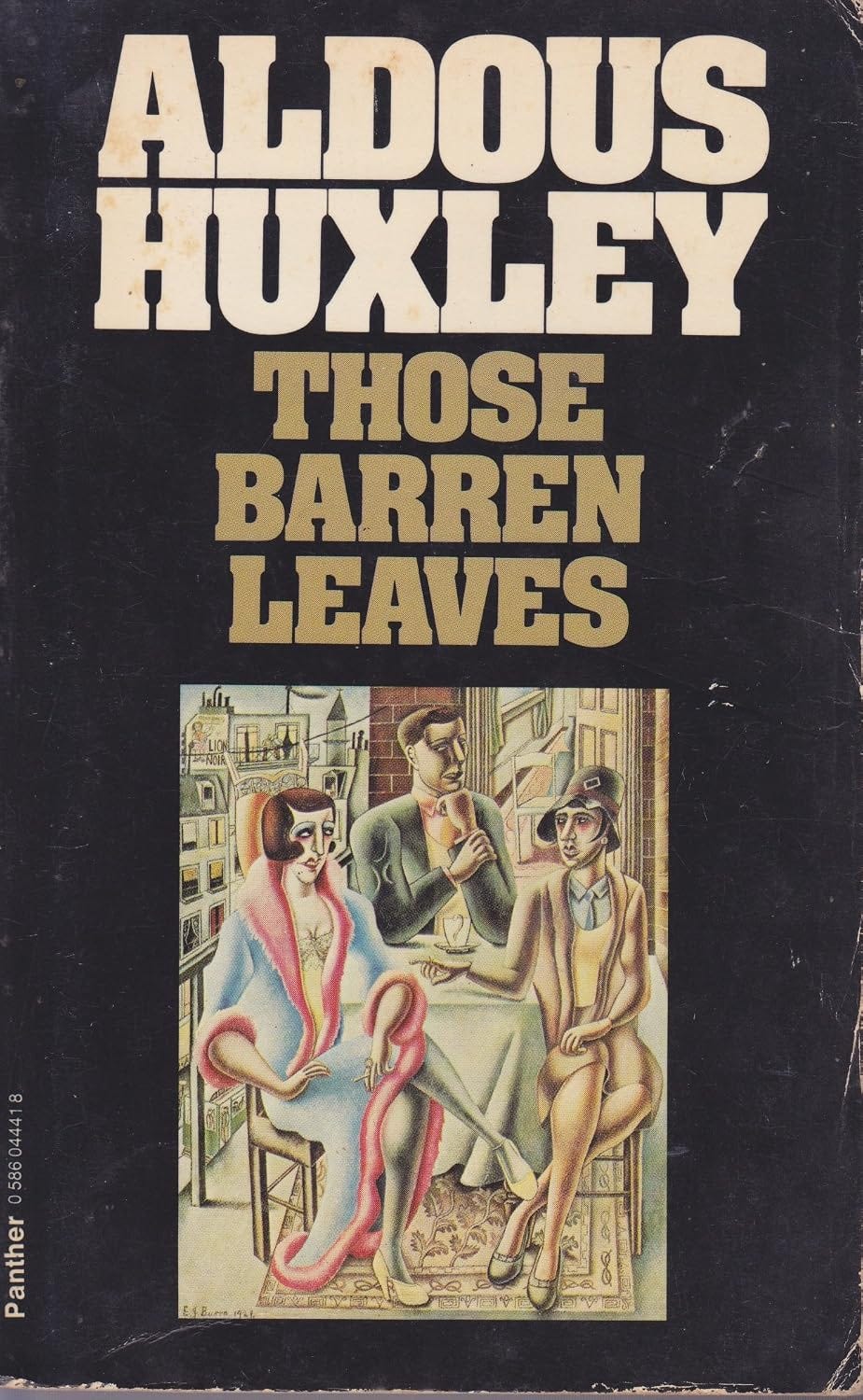
I’m not sure this observation by a critic is all that remarkable about Aldous Huxley. Almost every critic said similar things about his work. The first time I read this account, I admit I thought it pretty damned Weird. But what happened a few days later, to me, at work, was even weirder: I was working in a library in the wealthy suburb of Palos Verdes, near Los Angeles, re-shelving books, and gabbing with my brilliant gay friend, also shelving books. We were talking about books that we encountered on the floor, as if a patron had dropped the book there, or one fell or got knocked off a shelf accidentally, and we were coming up with very fanciful and laughable scenarios, most of them completely ridiculous and involving quantum mechanics, elves, mind control experiments, and an FBI cut-out group. I didn’t mention the Aldous and Laura Huxley story I’d recently read. A few minutes later we were in the Fiction section and I found a book in the carpeted aisle. It was Those Barren Leaves, a novel by Aldous Huxley. Instantly, I was “gone”: that state of mind in which you are so stunned, the world seems to stop. I admit I thought my friend had played a trick on me, but had I even mentioned Aldous Huxley to him? I don’t think I had. I’d remembered that he said his brother loved Aldous Huxley, but this was a few months earlier. I probably responded I that I loved Huxley too. Did he remember? We talked about literally hundreds of books and writers. That’s my only “explanation”: that he had remembered me saying I liked Aldous Huxley, and since we had been talking about books that showed up on the floor, he had dropped it there when I wasn’t looking. But he didn’t know I had just been kinda weirded-out by the Laura Huxley and Keith Rinehart “contact” with Aldous thing.
Hey: Aldous was prolific; there are lots of his books on shelves all over the world, and if a book were to get knocked off a shelf, or dropped there accidentally by someone, possibly carrying too many books to check out? Of all the authors to have books knocked off a shelf, he’s got a lot of them as candidates…I don’t know. I didn’t even mention this to my friend, who didn’t notice I had suddenly gone into an altered state. I felt like saying to the ceiling, “Am I on Candid Camera?” Aldous had been my favorite writer for years, and at that point in my life, Robert Anton Wilson was sort of taking over with me. To this day, these two writers have been more influential in my life than anyone else. Did my mind somehow get that novel onto the floor? Some sort of unconscious psychokinesis? Preposterous!
This was over 30 years ago, and as I recount this, I’m feeling a bit of a flashback. I think I thought, at this time, that if I mentioned to my co-worker/friend what had just happened it would come off as fake, too implausible, like I was being a drama queen and inventing marvelous tales. On the face of it, this event feels bogus. But it happened. I admit that it sounds hokey. There really is and was the palpable feeling that the universe is testing me to see how fragile I really was. Which sounds nuts, I know. I knew my friend would have been open-minded about it if I talked about what had just happened. He was a poet-intellectual then heavily in the throes of T.S. Eliot and Wm. S. Burroughs. He loved the marvelous and unexplained too. But I was too weirded-out to mention what had occurred. Possibly, if I had said, “Nice Aldous Huxley joke you pulled there” he might have giggled a little and copped to a prank. As I recall I might have suspected I was having some sort of psychotic break. I was not, but…WTF was going on? This kind of thing just didn’t happen to me. But now it did. Can I actually explain it as a coincidence, and feel satisfied? It turns out I could not, but to this day, I’m not sure what was going on. I never got up the nerve to ask my friend, and I’m not sure why.
At some point you read these stories about books and bizarre events around them and just wonder. An author submitted a manuscript to a publisher, then waited for a response. Some time later the manuscript ended up in his garden. Angrily the writer called the publisher and demanded to know what was going on. The publisher said she was impressed with the work, but it had been stolen the previous night from her car, along with other items, while she was eating in a restaurant. The publisher guessed that the thief or thieves hadn’t been as impressed as she was and had simply thrown it over a nearby garden fence. I wonder if the thieves felt bad and spied an address of the author and found his house and threw it into the garden. I don’t know. Artist-friendly intellectual-property-sensitive thieves.
A poet named Simon Armitage found his own book of poetry thrown in the trash bin outside a thrift store. Inside the book was his inscription, “To Mum and Dad.” This story was included in the book, Mortification: Writers’ Stories of Their Public Shame.6
There are books that appear in wild anecdotes and you just wonder - or, speak for myself, I wonder - whatever happened to the book. Ramparts editor Warren Hinckle writes about the CIA adrenaline junky pilot they hired to go to the Russian embassy in Mexico City to circulate, it seems, the Jim Garrison story about JFK’s hit and see where it goes, and also: to ask the Russians what they have on Oswald and related people. This guy is only called “Hill” and who knows what his real name was. Hinckle didn’t know. At some point “Hill” made himself so conspicuous he noticed he was being followed. He noticed that his tail had a tail. That old trick.7 “Hill quite understandably gave thought to the damage possible to his CIA meal ticket, or his person, lest the word get back to Langley, Virginia, that one of their pilots was fraternizing with the enemy. But the lure of rubbing noses with the KGB eventually overshadowed any cautionary reserves in his nature.” Eventually a Russian approached “Hill” and asked for the camera around his neck, promising to give it back, which he did, and it was “in better working order than when I gave it to him.” Hill talked for two hours with the Russian, and “Hill” explained the Garrison thesis. The Russian nodded, especially when the CIA was mentioned. “Hill” asked politely for “sanitized information the Russians had on Oswald” and others. A few days later the Russian told “Hill”: “What you request is not impossible. But it is not necessary that it will happen. The only way that it could possibly occur is in a way that would be most unexpected, and untraceable to its source. Something might be left in your hands, for instance, by a visitor to your country. That is all for now.” That old spiel.
The Russian smiled, extended his hand, and asked, “Do you like books?” “Hill” said he did. The Russian gave him a few books on how the East and West might better understand each other in the future. “Hill” had come unprepared for a book exchange, but remembered he had something in his knapsack: an R. Crumb comic book. He gave it to the Russian, who was appreciative, but admitted he was unfamiliar with the idiomatic phrase, “gimme some reds,” and that he would have it translated.8 I often wonder about that R. Crumb comic book, and how it might have influenced the Cold War…
Here’s one we need to explain away with all alacrity: In 1972 the very great actor Anthony Hopkins was in London to buy a copy of George Feifer’s novel The Girl From Petrovka because he was going to be in a film based on that novel. None of the bookstores in London had it, so he went home empty-handed, and entered the underground to catch the train at Leicester Square. He noticed an abandoned book on a bench. Of course it was The Girl From Petrovka. Probably just a coincidence. We all know that feeling of not being able to find a book and then it just shows up in public, unattended. By which I mean: no one knows this feeling, are you fucking kidding me? It gets better.
Hopkins begins flipping through the pages and it has marginalia, like how to change English spellings to American English, like from “labour” to “labor,” etc. Months go by and Hopkins is filming the movie. George Feifer is on the set, and Hopkins mentions the weird story about finding the copy in the underground. Feifer asks to see the copy. It had been his own. He was the one who had made the marginalia, in preparation for a possible American-made version of the film. One of Feifer’s friends had borrowed the book and lost it near Baywater, Central London.
I read this anecdote in Annie Jacobsen’s book9 on the US government’s long stealthy search into ESP and everything lumped under psychic phenomena. She heard the story of The Girl From Petrovka on the radio in a car. It was explained away as mathematically common, and subject to the Law of Large Numbers. This kind of thing happens all the time. It could explain me finding Those Barren Leaves by Aldous Huxley in the library aisle, on the floor. Our minds don’t find such things intuitive at all. Rather the opposite: they seem incredibly uncanny. Almost unexplainable. And here I was, reading Jabobsen at the end of her 527 page book on the CIA investing in remote viewing (and finding some people can do it?), etc. She wondered: okay, it’s all explainable by the mathematics of large numbers…so why were these CIA types - Ivy Leaguers, often - so completely in thrall to PSI phenomena? Don’t they have a massive squad of mathematicians, too? Are they not listening to the Law of Large Numbers? Why?
I leave off with one of my faves: the case of the locked-up copy of Illuminatus! When Robert Anton Wilson was in Europe before the fall of the Berlin Wall, he learned there had been some blotter acid with the eye in the pyramid on it, and it was competing with Gorby acid: Gorbachev’s face on a hit. He also had read about a German hacker who had died mysteriously, had hacked into the Pentagon and such. He had been completely in thrall to Illuminatus!, it turned out. An article about the hacker (who was named Karl Koch, but in Cosmic Trigger vol II RAW thinks he’s “Klaus") showed a picture of Koch’s computer, with a copy of Illuminatus! on top; Koch had written articles for the anarchist press in Germany under the nym “Hagbard Celine.” RAW surmised - I think, no doubt correctly - that had the CIA not already read Illuminatus! very closely, they must do so now. RAW notes they’d add this analysis to the already “thick dossier” he imagined they had on him. RAW heard rumors the KGB and the CIA had tried to recruit Karl Koch.
Then RAW went to a dinner given by the punk rock group The Klingons and met a young man who had escaped East Germany and told Wilson a story of a weird copy of Illuminatus!: in Leipzig, there was a public library that wasn’t open to the public, but housed heretical books. RAW wondered why they didn’t burn them and guessed maybe the members of the E. German communist party liked to read dangerous books themselves?
My young informant told me he decided to burglarize the library. With patience and observation, he found a way to get in at night and grab a few books now and then. He always returned them, to avoid arousing suspicion, after reading their Heretical Ideas. When he made his escape to the West, he brought only one of those forbidden books with him.
He put it on the table. It was Illuminatus! “would you please autograph it?” he asked.
I was overwhelmed. The thought of my book locked in a sealed library by Communist officials who did not want to burn it outright was dramatic enough, but having the book stolen and offered to me for an autograph was so weird I wondered if anyone would ever believe this story.
I opened the book to sign it and found on the inside front cover the words RAJNEESH INTERNATIONAL LIBRARY.
Is (or was) the Rajneesh International Library in Poona, India, at his original Ashram, or in his later Oregon ashram? How the hell did the book get from either India or Oregon to the hands of a Communist official in East Germany, who decided to preserve it in a sealed library?10
RAW considered this phenomena from a Jungian synchronicity perspective, and also from the POV of the acceleration of acceleration of information in our world, and chaos mathematics, a fractal process of in-form-ation. I think humans who are attracted to the book-world have a quality of sociality that would seem to encourage odd travels of books and a noticing when certain copies - which we often mark as distinctly our own - turn up in odd places. But I will not dogmatize at this moment.
With perspective of almost 40 years since RAW’s trip to Europe and Germany, that world feels like Rebecca Of Sunnybrook Farm or Goodnight Moon to me, in the US of 2026.
“Shun Fu: Floating Life In A Fallen Realm,” by Jeremiah Jenne, a UC Davis-trained Sinologist.
Lin Yu-Tang’s English translation goes under Six Chapters Of A Floating Life, while the version from Chiang Su-Hui and Leonard Pratt used the title Six Records Of A Floating Life. I find natural affinity with those living the floating life, having done much floating in my days and nights.
Books: A Memoir, McMurtry, p.238
Her copy had been bought in Providence, then she took it with her to Haverford, PA, to Fayetteville, AK, then on to Hamilton, Ontario, then it was lost. Now see HERE, you!
I first read about this account in Robert Anton Wilson’s Cosmic Trigger, vol. 1, pp.72-73. His source was Laura Archera Huxley’s memoir, This Timeless Moment, p.236. I can’t even come close to explaining my own synchronicity with a book here, aside from a fortuitous prank by my friend, made weirder by the fact I’d recently read about Aldous’s supposed contact with his wife from the realm of the dead. Neal Wilgus reports a long string of “bibliographical synchronicity” events that seemed to ensue after his own encounter with RAW’s Cosmic Trigger, vol 1; see Wilgus’s The Illuminoids: Secret Societies and Political Paranoia, pp.254-257. The idea is if you immerse yourself in arcane knowledge, strange subrosa machinations and the occult in general, then you invite this sort of weirdness upon yourself, but hardly anyone is sufficiently prepared to deal with it. The “rationalist” take would be it’s all a coincidence, and you’re preparing your mind to “notice” what was always there, but because of the sets and settings you’d gotten yourself into, it’s all too freaky and unexplainable. RAW himself coined the term “coincidance” to counter this Nothing-But mode of overly “rational” thinking. You have to figure this stuff out for yourself, or so I’ve convinced myself over the years. No one can do it for you. That’s part of the Initiation.
The manuscript found in the garden and the poetry book in the trash bin are items I found in Beyond Coincidence, by Plimmer and King, p. 118 and p.127, respectively. The poet’s book to “Mum and Dad” was by the celebrated poet Simon Armitage, and Robin Robertson was the author of Mortification. Robertson wrote a smashingly good book on Los Angeles history and film noir, The Long Take, which I’ll be writing about here at the OG at some point, or so I hope.
If you’re paranoid and think you might have someone following you, you then notice they made a turn and are no longer following you, so you relax. It was all just your imagination. That’s when the tail’s tail picks you up and tracks you. CHILL! Why would anyone be tailing you, though, Dear Reader?
If You Have A Lemon, Make Lemonade, Warren Hinckle, pp.247-250.
Phenomena: The Secret History of the US Government’s Investigation Into Extrasensory Perception and Psychokinesis, Annie Jacobsen, pp.421-422.
Cosmic Trigger vol II, p. 244-245, or the Hilaritas Press ed. See the short piece, “Gorby Acid…and the Fall of the Berlin Wall” in other editions, pagination slightly different in those. There’s a German feature film about Koch (23, 1998, Hans Christian Schmid) that I saw in Los Angeles not long after it premiered. RAW was in it, wanted to see it, but I don’t know if he ever did. He seemed miffed that I had seen it while he missed it. It was “this year’s German films” fest in LA, that I recall. I remember a huge billboard on the 110 freeway on the way there for the California lottery: now at $23 million. Koch was found dead on May 23, 1989, supposedly a suicide, though it’s easy to see why the CIA, the KGB and any number of other alphabet soup groups would want the guy dusted.

I love stories about books.
I have actually visited Larry McMurtry's bookstore, one or two times. For many years, I lived in Lawton, Oklahoma, about a 45-minute drive from Wichita Falls, Texas. McMurtry's bookstore was in a group of buildings in Archer City, near Wichita Falls. I can't even remember if I found anything there. But I do remember McMurtry sitting behind the counter and politely thanking me when I talked about how great "Lonesome Dove" was. I got into trouble for one of those trips. My ex-wife was too shy to visit and meet McMurtry, so I took her. It was a perfectly innocent thing to do, an act of kindness, but I got into trouble with the woman who became my next wife.
One of the advantages of going to science fiction conventions and mystery conventions is that you hear book stories. Your story about the poet finding the book he inscribed to his parents reminded me of hearing a science fiction writer complain about books he had autographed turning up in used bookstores. The proposed solution was to autograph books with inscriptions such as, "To John, in memory of a night of forbidden pleasure."
The story about the author waiting for a response from the publisher reminded me of a story my wife heard at a mystery convention. A writer was angry that an agent hadn't responded to his latest book. When he complained about it to another writer, the second exclaimed, "He's dead!"
For years, I used to correspond with a Russian science fiction fan named Boris Zavgorodny, who lived in Volgograd. I would send him books and other items of interest (for example, an obituary from "Locus" when Robert Heinlein died) and he would send me stuff. One of the books he sent was a translation into Russian of a book written by Isaac Asimov. Asimov was probably my favorite writer when I was a teenager. I finally encountered him for a few seconds at a convention at the 1989 Boston Worldcon. Asimov exclaimed, "That's in Russian!" and obligingly signed it. But I didn't keep it! I mailed to Boris with the autograph. I still think that's probably the best book gift I ever gave anyone.
Conventions are kind of hit and miss for meeting writers. I did meet or at least hear many of my favorite SF writers, but I missed a few. One miss that I regret is the 1986 Worldcon in Atlanta, one of my favorite worldcons of all time. It was only years later that I learned "Illuminatus!' had received the Prometheus Hall of Fame Award at the convention, and that Robert Shea had been there to accept it. Somehow although I was at the convention, I did not hear about that particular program segment. I didn't know Shea was at the 1989 Worldcon in Boston, either, but I went to a room party for the Golden APA (I had an old friend who was in the apa), and Shea was there! It was very cool to meet him. But I regret that, at the time, I had not read any of his solo novels. It would have been cool to talk to Shea about "Shike" and "All Things Are Lights," instead of just "Illuminatus!"
Great piece. Sorry it took me so long to comment on it. It made me think about the difficulty in finding books in pre-internet days. In 1983 I read about Theodore Sturgeon telling Harlan Ellison he considered Christopher Logue's translation of Pablo Neruda's "Love Poem Number 20" the saddest poem in English. I searched for that poem for years. I read a ton of Logue and a ton of Neruda (by other translators). I even met W. S. Merwin and talked with him about his Neruda transtions. Then I finally found a copy of a Logue book in the University of Arizona library in Tuscon that included his transation of "Love Poem Number 20". I checked the table of contents, saw the page number of that translation, turned to that page, but someone had torn the page out. (This also happened to me with Eliot's Prufrock the first time I tried to read it. Someone had torn Prufrock out of the Arizona State Library book containing it. People used to tear their favorite poems out of library books just as people used to tear pages from phone books.) I did eventually find a copy of Logue's translation of the poem, and I loved it.