
September 18, 1966
Charles Percy was running for the Senate in Illinois. It was September 18, 1966. He was a few points behind in at least one poll. That night someone murdered his 21 year old daughter in their house, in her bed. The case has never been solved, although when anyone reads about it they will notice a quite different American justice system. The Illinois police followed up on over 1300 leads, interviewed over 14,000 people, and spent $300,000 trying to find the murderer(s). Percy suspended his campaign for two weeks, then beat the Democrat in the election.
The cops zeroed in on two guys linked to the Mob, who specialized in breaking and entering and stealing from wealthy homes, having stolen over $3 million in jewels and cash from homes. One of the two guys allegedly confessed to friends and acquaintances that he murdered the girl because she woke up. Nothing was stolen from the Percy household that night and no physical evidence linked the two suspects to the crime, so they skated. But Valerie Percy, the Senator’s daughter, was dead.
Her father, Charles Percy, was for the Vietnam War, and when Nixon declared the War On Drugs in 1968, Percy was one of the point men for Nixon. In 1994, Nixon’s domestic policy man, John Ehrlichman, told journalist Dan Baum that the War On Drugs was a war on the two groups that opposed them most visibly: the Blacks and the Anti-War Left. Nixon declared the most dangerous man in America to be…Timothy Leary.
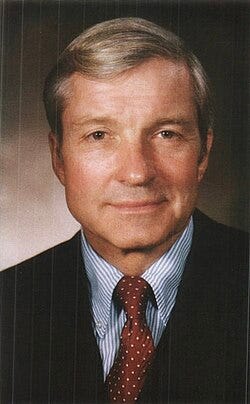
(Senator Percy, Republican from Illinois, 1967-1985)
Ehrlichman in 1994:
The Nixon campaign in 1968, and the Nixon White House after that, had two enemies: the antiwar left and Black people. You understand what I’m saying? We knew we couldn’t make it illegal to be either against the war or Black, but by getting the public to associate the hippies with marijuana and Blacks with heroin, and then criminalizing both heavily, we could disrupt those communities. We could arrest their leaders, raid their homes, break up their meetings, and vilify them night after night on the evening news. Did we know we were lying about the drugs? Of course we did.1
New Senator Percy chimed in for Nixon and other Republicans, suddenly in the news everywhere making up numbers and diverting attention from what was looking like a disastrous war, which would go on for another six years. The conservative think tank The Hudson Institute claimed there were a quarter of a million heroin addicts in New York City alone, and they were responsible for $1.7 billion in crime, worth more than the total amount of crime in the entire US. Senator Percy claimed, “The total cost of drug-related crime in the US today is around $10 billion to $15 billion.”2
Percy stayed in the Senate until 1985, when he was defeated by Paul Simon. Many sources link Percy’s defeat to AIPAC: he’d been a little too outspoken about Israel. While in office he ended the practice of nominating Federal judges from the political machine in Chicago, instead consulting with legal experts, including the ABA. One of the judges that came out of this was John Paul Stevens, who later served as one of the last male adults on the SCOTUS. Percy once said that The Autobiography of Malcolm X was a book that moved him greatly, and he thought more white people should read it. Based on his enquiries about health effects of Agent Orange and other defoliants sprayed on US troops in ‘Nam, he played a part in getting the US government to stop spraying paraquat on the Mexican cannabis crop.3
In 1968, as Percy found his stride in the Senate, Robert Anton Wilson was living in Chicago and working with his friend Robert Shea at Playboy, answering questions for the Playboy Advisor, with humor and in the intellectual libertarianism they shared with Hefner. He was also writing under pseudonyms for anarchist magazines, like the Spark and the Chicago Seed.
In 1971 RAW wrote a letter to his Senator, Charles Percy, telling him the CIA was involved in the opium trade in Laos. RAW got this from his colleague Allen Ginsberg, who…had his sources. RAW sent Percy clippings from the Chicago Daily News, about Ginsberg’s claim. He also sent elaborated information about this topic from the Spark, and cited Joel Fort’s very recent book The Pleasure Seekers, which also contained information on the topic, and wrote that the latest issue of Ramparts magazine would have even more information. From RAW’s letter to Charles Percy:
If the fundamental facts in these stories are true, the heroin that is killing our children in America today is being brought here partly due to our government’s attempts to preserve corrupt dictatorships. It seems that not only is our government willing to kill our young men when they reach 18, but is also willing to expose them to heroin in their own neighborhoods, just to protect whatever interests it has, or imagines it has, in the Far East.4
Subsequent findings proved RAW’s info from Ginsberg not only accurate, but the tip of the iceberg. Alfred W. McCoy would blow the lid off this whole thing with one of the greatest exposés in history, The Politics of Heroin in Southeast Asia, in 1972. One wonders what the young Senator and Drug Warrior from Illinois, Charles Percy, made of all these radicals asserting such stuff. Was he “in” on what Ehrlichman said, that of course the war on drugs was a war on the enemies of Nixon? Or was Percy what the CIA calls “a Useful Idiot”?
October 3, 1976, Exactly 10 Years and 15 Days After Percy’s Daughter Was Murdered
In Berkeley, CA, Wilson’s teenaged daughter Luna, beloved free spirit, was murdered by a troubled man in the back of a clothing store on Telegraph Ave. Another botched burglary. He tied her up and bashed her head in with a credit card machine.5 This case, unlike Senator Percy’s daughter’s murder, was solved.6
Suddenly, Wilson had a fellow in grief: Republican Senator Charles Percy. In a letter dated January 1, 1978, 14 months after Luna’s murder, RAW writes his friend Timothy Leary:
Senator Percy said once that his whole family suffered emotional problems for over a year after the murder of his daughter, and I can fully appreciate what he meant by that.7
Early in the first volume of RAW’s Schrödinger’s Cat Trilogy of novels, The Universe Next Door, there’s a very Wilson-ish character, a columnist named Benny “Eggs” Benedict, whose mother went out for a walk, got mugged and stabbed several times with a Boy Scout knife, and died, murdered. He saw her body. The doctors gave him tranquilizers, as they did RAW after Luna’s murder.
Benny was crippled psychologically in a way he could not perfectly understand. After all, having reached the fifth decade of his life,8 he was well acquainted with grief: in the past ten years he had experienced the deaths of his father, his older brother, and three close friends. But murder is not just another form of grief: it is a metaphysical message, like Fate knocking on the door at the beginning of Beethoven’s Fifth.9
Benny begins to see the sadistic murderer everywhere, and worse, he’s always grinning. I think the idea of the grinning sadistic murderer gained a lot of valence in the wake of the Manson murders, of which…maybe later.
Then, one day looking through the old files in the newspaper morgue, Benny found an interview with Senator Charles Percy, given in 1970, two years after the murder of his own daughter. “For the first year after the murder,” Senator Percy said, “my whole family lived in terror.” Benny felt a sudden sense of relief. This must be normal, he thought; it happens to everybody who’s had a murder close to them. And it lasts only a year.10
Very soon after this, the year marker passes and Benny isn’t getting any better, his doctor ups his Valium dosage, and Benny is invited to give a talk, when some wild-eyed hippie type comes at him at the podium, Benny “sees” the Grinning Sadist with a knife, but…it’s a pie. He gets hit in the face with a pie. This too actually happened to Wilson: the person who hit him with a pie loudly called Wilson a “materialist!” as he launched the pie. For some reason, this episode reminds me of the rumble in the bowling alley parking lot in The Big Lebowski, where the opposition are a bunch of “nihilists.”11
Wilson received a strange offer just after Luna’s murder. In an interview only four months later:
Q: Your 15 year old daughter, Luna was murdered four months ago. Can you describe what happened?
RAW: Luna was beaten to death in the course of a burglary at a store where she was working. Right after Luna’s death I got a call from Paul Segal, who’d just got his PhD for research in stopping the aging process in rats three different ways. He acknowledges me as one of the people who helped him in his work. I didn’t do any of the research but he felt I’d contributed a lot to his work. Paul said he knew I didn’t have the money to to pay for cryogenic suspension, but he said we could get it done voluntarily and funds for the upkeep could be raised later. It turns out a lot of people in the immortalist movement were chipping in to help out and so on. So we had Luna preserved. All the work was done by the Bay Area Cryonic Society voluntarily as an expression of gratitude for the publicity I’d been giving their work. It’s probably the most deeply moving thing that has happened in my whole life.12
I’ve often wondered about the quality and lastingness of comfort of the Cryonics people and Senator Percy. I don’t know. Wilson discusses the persisting grief in the short vignette, “Bury My Heart At Wounded Knee,” in Cosmic Trigger vol 2: Down To Earth, writing that, given enough time, it seemed “mathematically certain” that Luna’s genetic material could be reanimated and that “science could give Luna a chance to live again.” But he would suddenly break into uncontrollable weeping. 13 In his journal of those years, Wilson’s friend, the UFO phenomenologist Jacques Vallee chalked up Luna’s death to the craziness of “Berkeley” and “drugs” at that time in history.14
RAW was always interested in causality and physics. Take any incident in your own life: how your parents met, the day a friend died in an accident, anything: what were all the possible events that led up to this and what little thing could have entirely changed the course of events? Much of the quantum theory that Wilson philosophizes with in the Schrödinger’s Cat Trilogy has this as its basis. RAW calls the short piece about his grief over Luna in 1977 “Bury My Heart At Wounded Knee” thus because:
The murderer was a Sioux Indian and an alcoholic, who had been at Wounded Knee when, according to eye witnesses, the FBI opened fire on unarmed Native American demonstrators and killed several. I could not think of him without seeing him as the resultant of all the horrors and atrocities committed against the Native Americans since we whites first arrived here. My rage went through him and past him to include the whole structure of Christian bigotry, white racism and Capitalist greed that had made the genocide of the Native Americans inevitable - and made the high alcoholism and violence rate of the survivors equally inevitable.15
This was why, should the death penalty have been in play for LeBeau, RAW and his wife Arlen would have been against it.
In Ed Sanders’s book on the Manson murder cult, The Family, there’s a bit about the paranoid aftermath that was teeming, all over the US, but especially in the hills above Hollywood. The magickian-Sufi E.J. Gold had had a “cult of evil” (that really wasn’t), near the Hollywood hills at that time, and though Gold was more of a prankster-provocateur than anything pernicious, he and his colleagues certainly caused creeped-out spooks to look into him and other Thelemites and Crowley-like adepts and writers about Crowley.16
This may have fed some of RAW’s paranoia around this, though the story of his “paranoia” can be the subject of your own 10,000 word essay. Arlen was asked about RAW going to antiwar meetings in which it was assumed at least half the members were spies for the local police, or allied with the FBI or any other group: she said he was the least paranoid person she’d ever known. As RAW often wrote: paranoia is a losing script. Nevertheless: the Manson murders seven years earlier had certainly made people in the counterculture more wary.
There’s a very interesting passage in RAW’s novel Masks of the Illuminati, where George Cecil Jones, a Crowley adept, is teaching the Probationer Sir John Babcock about magick via the Golden Dawn system. A news story about a “mangler” murderer near Loch Ness on the loose appears in the newspaper, and then the idea that other papers will pick this story up and it’s going to be big news. Babcock asks, Is that bad or good? Jones replies:
“It’s the very worst thing that can happen,” he said with grinding patience. “You should understand by now that human belief-systems determine human experience. Why do you think the Invisible College remains Invisible? Why do you suppose we don’t perform miracles on every street corner and convert the multitudes? Don’t you realize that the philosophy of materialism is the best thing that ever happened to Europe?”
“You are talking in paradoxes,” Sir John complained, noticing that the fog outside was beginning to thicken.
Jones points out that once a haunted house story appears in the papers, people experience haunted houses everywhere. Jones asks Babcock, “Why do you think the Buddha said, ‘All that we are is the result of all that we have thought.’?”
Jones says that stories like this “mangler” murderer on the loose create its own reality, and opens up more people to fear, paranoia, copycat killers, more murder, but the the simple uneducated people have Faith that they will be protected, while the “educated” - the “equally automated morons turned out in platoons by the universities have a simple skepticism, which also protects them.” But the true Adept realizes that phenomenon such as a scare creates the possibility of alternations between Faith and Skepticism, which lead to true enlightenment. Crowley himself had once explained this endless series gnomically thus: “?!?!?!?!?!?!?!?!?!?!…”17
It’s not difficult to do some research and find some group of sickos who committed some atrocity because they were influenced by the Manson family murders. And how did they find out about these atrocities? We create reality and yet do we have agency over what we pay attention and lend weight to?
As for causality, there’s no end, but I re-read Pynchon’s Vineland yet again not too long ago. For those who know, leftist guerrilla filmmaker Frenesi Gates gets turned in the Drug War Snitch Culture, and gets involved in a plot to get rid of a very popular psychedelics-using Math Professor. And Pynchon addresses this very much as RAW did when thinking of the infiniteness of causality.18 Was Weed Atman’s Bardo Adventure and murder easy to limn? No: Rex shot Weed, with Frenesi instigating, but Brock Vond got Frenesi to “turn”, and why were those drugs illegal in the first place? What kind of value system gives rise to such persecution?, etc: who’s fault? In our Western system of Law, we forget all this and mostly only concern ourselves with the final actions. Some people get busted for being a part of the crime in some capacity. There are limits to culpability that seem human, all-too human in their legalistic reasoning and precedent cases, etc. And yet: nothing in our lives - how you happen to be reading this, for example - has one simple cause. And I don’t think we can account for it. We tend to find the idea ludicrous, for….reasons. “Not practical,” even if true. I get it. But was Benny “Eggs” Benedict correct? Is murder a “metaphysical message” for the survivors? Who in our world sees it this way?
RIP Valerie Percy, died September 18, 1966
RIP Patricia Luna Wilson, died October 3, 1976
Take a gander HERE. By the way, in your own personal taxonomy of “conspiracy theories” how does this one rank, if at all?
“Treatment Or Jail: Is This Really A Choice?, Preston Peet, Everything You Know Is Wrong: The Disinformation Guide to Secrets and Lies, ed. Russ Kick, pp.145-150. The Percy quote is on p.146. Percy’s quote of $15 billion in 1968 must be factored in: $100 in 1968 is roughly equal to $962 today. Could Percy have actually believed this at the time?
Seeing Through The Smoke: A Cannabis Specialist Untangles the Truth About Marijuana, Peter Grinspoon, pp. 85-86.
letter dated May 6, 1971. RAW sent copies of this letter to Senator Fulbright, Jack Anderson and Mike Royko of the Daily News, and I.F. Stone. This letter was found and retrieved from the Ed Sanders Archive at Princeton, by Bobby Campbell. Ginsberg was at the same DC cocktail party as CIA Director Richard Helms, and said out loud that he could prove that the CIA was involved in heroin smuggling, and they made a bet right there in front of everyone. I wonder if Helms, “The Man Who Kept The Secrets”, ever paid up.
RAW wrote about this very soon after it happened. His now-famous underground classic Cosmic Trigger vol 1 was published in 1977. For relevant pages on Luna, see pp.78; 81, 135-136. For pages on Luna’s last days and the aftermath, see. 237-244. Luna appears to have been an extraordinarily intuitive kid with a crazy amount of charisma. So much so that eight years ago a poetic graphic novel was published about her friendship with Luna by one of her childhood friends in 1970s Berkeley, Rebecca Fish Ewan. See her By The Forces Of Gravity: A Memoir of Loving Luna. (2018)
RAW’s biographer, Gabriel Kennedy, did a follow-up investigation on Alex N. Lebeau, HERE. As far as I know, RAW never wrote LeBeau’s name, at least in his books and articles extant. That LeBeau got a mere five years for this!
RAW letter to Leary 1/1/78 from the Leary Archives at the NY Public Library.
RAW was 44 when Luna was murdered. “Benny” is a character who could have been RAW, but here he is in another quantum universe.
Schrödinger’s Cat Trilogy, omnibus ed, p.19.
SCT, p.20. Percy’s daughter was murdered in 1966, not 1968, but this is a different universe in which some things are in “our” universe, while other things are wildly and significantly different, although in September 2026 things are looking somewhat like the universe of The Universe Next Door…which…doesn’t end well, does it?
Or more recently, the Zizian cult of killers, who are/were “Rationalists.”
Luna was the first person to have her brain preserved by the American Cryonics Society, which was then called the Bay Area Cryonics Society. Interview: Weird Trips, 1977.
Cosmic Trigger vol 2: Down To Earth, pp.81-83, New Falcon ed.
Forbidden Science 2, Vallee, p.371. Vallee really does come off as a straight guy through all his work. He had friends like Anton LaVey, a wonderful weirdo also pretty straight vis a vis drugs. As the discussion of causality builds later, I think it far too facile to cite “drugs” and “Berkeley” as the proximate cause of Luna’s death.
Cosmic Trigger vol 2: Down To Earth, p.82. We recognize this thinking about suffering and our place in the planet as Buddhist, and RAW was something of a Boddhisattva.
There exists, apparently, a few varying editions of The Family, Sanders’s wonderfully evocative, creepy, and quasi-Gonzo “investigative poetry” and reporting on the high weirdness around the Manson family. I draw here from the 2002 ed. from Thunder’s Mouth Press, pp. 408-409, which relates Sanders’s interview with “Morloch The Warlock,” AKA EJ Gold. Gold claimed Sharon Tate and Abigail Folger attended his Magical Mystery Museum about a month before they were slaughtered. From Sanders, quoting his own account: “Morloch is a Crowley-phile, having in his possession many of Crowley’s magical documents - including, evidently, the original manuscript of Liber Legis.” That would be the Book of the Law, the central sacred text of Thelema. Gold cites Diane Linkletter, too, and it’s all really quite a bit much, but see for yourself. My gawd those were insane times.
Masks Of The Illuminati, pp.252-254. I often frame this as Hume pragmatized. Yes, skepticism. But not knee-jerk skepticism, as there more things in heaven and earth, etc. Tentative belief that something marvelous might be true: what are the consequences of such thinking? Then: skepticism again. We tentatively arrive at a “model” of certain phenomena that we favor more than others, but there’s always that skepticism, if for only the glaring idea: how likely is it that we hold the entire Truth about some phenomenon, right now? Not bloody likely! Not at all! Keep an open mind, but know it’s your instrument - your nervous system - that’s doing the recording. RAW called this system writ large: Model Agnosticism. I think it makes us smarter, funnier and happier. As of this date…
See Vineland, pp.364-366. As for multiple causality and unforeseen consequences, D. Scott Apel, was a friend of Wilson’s for 30 years. He relates a story of a beer-party with friends many years after he first met RAW. Getting a beer buzz, a friend asked Apel why he never had kids. “I was drunk enough to tell them my deepest, darkest secret: ‘I’d never had kids because I was afraid they’d die. That’s the worst thing that can happen to a human being, and I couldn’t handle it. It would break me.’ They laughed and called bullshit. Clearly, they’d never had a friend whose child had died. I had four, including the Wilsons.” - from Apel’s essay about his friendship with RAW, in Beyond Chaos and Beyond, p.404.
(artwerk courtesy of Bob Campbell)
This is one of your best pieces. To tell you the truth, I was a bit spooked that this posted the same morning as I posted the news on my blog about another of RAW's daughters dying, Alex Gardner. I even wrote in the post that Alex is mentioned in "Cosmic Trigger." Not the kind of RAW-Jung "synchronicity" I was looking for. (If it isn't clear, Michael and I had no idea what each of us was working on.)
We are going to do a "Schroedinger's Cat" online reading group soon at the blog, and this post is good background for that.
Great piece on the strange, shifting mists hovering over consciousness that make certainty in our affairs so inconceivable.
Mob-linked burglar+drug trafficker Frank Hohimer was implicated in Valerie Percy's murder by Leo Rugendorf, his boss in the Chicago Outfit (who hated Percy). Hohimer's brother also suspected him+told the FBI that Frank had acted suspiciously right after the murder. Hohimer wrote a curious memoir, The Home Invaders, which Michael Mann partially copped for his first movie, Thief with James Caan.