Hyperobject: Internet
A book review and two film reviews

One of my favorite of the still-living weirdo philosophers, Timothy Morton, coined the term “hyperobjects” for all those Things (I capitalize in a Lovecraftian sense here) that are non-local and dwarf our ability to comprehend them in their totalities. While Internet is one, I hate to lay it on ya, but there are many more: evolution, relativity, non-locality in quantum mechanics, nuclear weapons, global warming, microplastics, pandemics, styrofoam, AI, fascist ideologies, etc: it’s the Blind Men and the Elephant story times a million. We can all see parts of these things, but we cannot encompass these things in their totality at all. No one can. If anyone says, “Lemme tell you all about (any one of these things), ask me anything,” you’re talking to someone who doesn’t know what they don’t know.
This is how I tend to approach Internet. I don’t say “the Internet" for roughly the same reasons no one says “the global warming.”
What Tech Calls Thinking: An Inquiry Into the Intellectual Bedrock of Silicon Valley, Adrian Daub, Farrar, Strauss and Giroux, 2020, 152 pages.
Lo and Behold: Reveries of the Connected World (2016, Werner Herzog), 98 mins.
The Net (2003, Lutz Dammbeck), 121 mins.
When I first saw the title of Daub’s book I thought it might be a critique of AI, but that’s not what this slim volume is about at all; the subtitle is the giveaway here. Daub is a comparative lit and German Studies prof at Stanford, and his situatedness in Silicon Valley gives his narrative a dash more gravitas; he can just ask a colleague or student and they’ll tell them all kinds of things. But mostly he reads.
Broken into chapters “Dropping Out,” “Content,” “Genius,” “Communication,” “Desire,” “Disruption,” and my personal fave, “Failure”, this extended essay of a book extended my understanding of Silicon Valley I’d mostly gleaned from Fred Turner’s From Counterculture to Cyberculture, What The Dormouse Said by John Markoff, and extended rifflings and grazings through and in Adam Fisher’s Valley of Genius: The Uncensored History of Silicon Valley (As Told by the Hackers, Founders and Freaks Who Made It Boom). I also watched the entire run of HBO’s parody/satire of start-ups, Silicon Valley (Mike Judge, et.al, 2014-2019). I kept wondering how many inside jokes I was missing in the TV show: Is this Asperger-y tech billionaire clod supposed to be based on…???
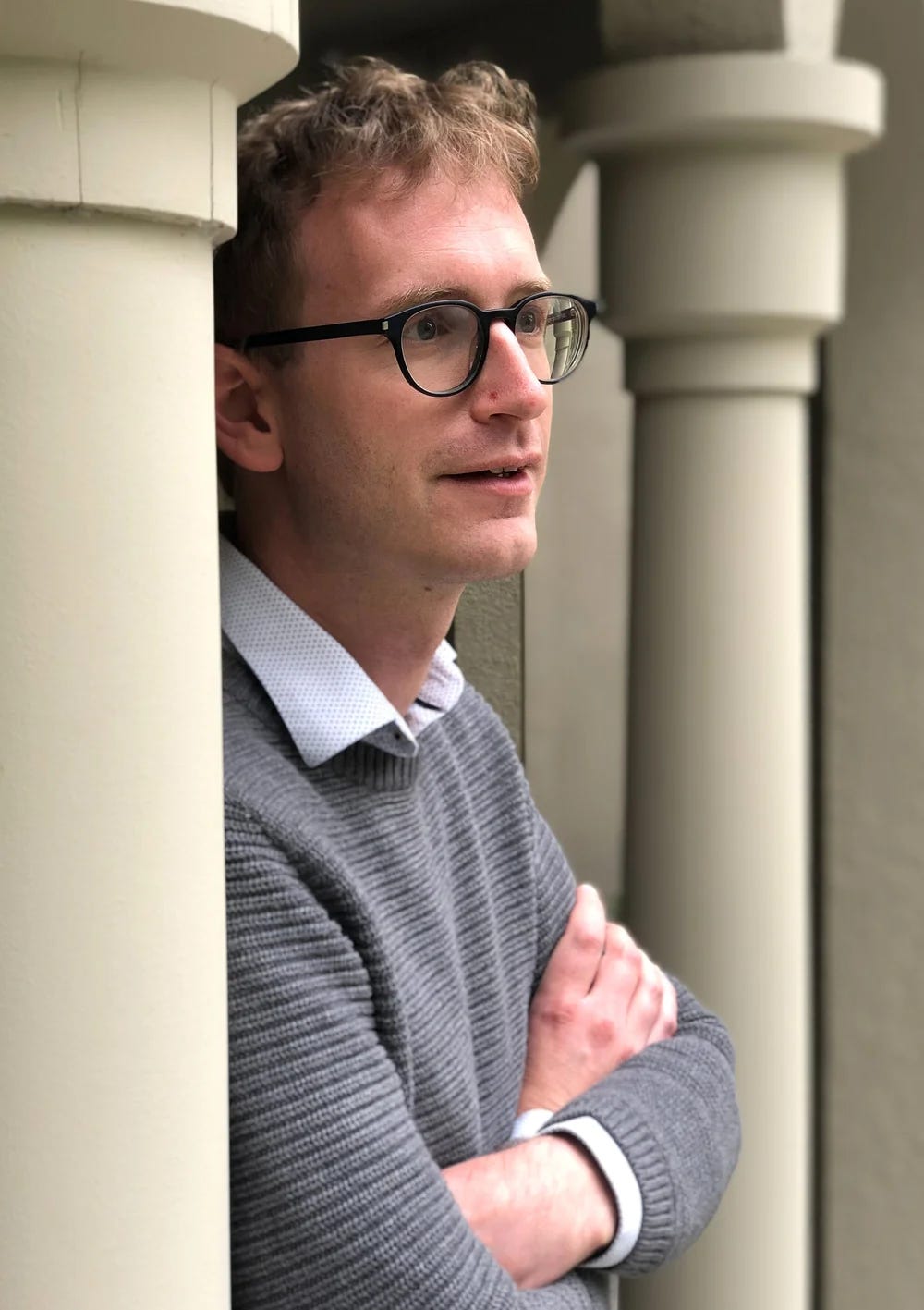
(comp lit/German prof Adrian Daub, of Stanford)
In other words, I know almost nothing. I find it striking that, when I think of the work of Daub, Herzog and Dammbeck here, I find my right hemisphere guides me based on what I’ve read from counterculture figures who were once insider-idealists and who have now grown very critical: Douglas Rushkoff, but especially Jaron Lanier, a pioneer in virtual reality but who started blowing whistles about digital tech before Obama first got elected. Before Facebook took off. 1
Daub emphasizes California history and the neurogeography of ideas pre-Internet: Esalen, Berkeley, sprawling office parks in the South Bay area near San Francisco, but especially, Stanford. Which seems weird, because the hallmark of Internet is that it effectively obliterates space. And I assume, based on Erving Goffman’s work, that the Interaction Ritual - thinkers meeting in hacker-speaks’s “meatspace” - has a valence that’s underrated. We can all use our library card to check out a book by Rene Girard, but Peter Thiel sat at this guru’s feet at Stanford (see the chapter “Desire”). For Goffman, the Interaction Ritual generated emotional energy in a way that emailing each other cannot. Interaction rituals contain enormous amounts of information we don’t find virtually: greetings, body language, and the sacredness of simple, symbolic acts. It’s one thing to exchange phone calls or emails with a colleague; it’s quite another (now, seemingly increasingly forgotten) to be incarnate with them for many hours. (Goffman’s work is not mentioned by Daub but it could have been. Daub is concise and this is a short but rich book that can be read in two days.)
For “Dropping Out” Daub illustrates the quasi-occult links to Timothy Leary, Allen Ginsberg, Hermann Hesse, Aldous Huxley, Ken Kesey, Jack Kerouac, and Robert Heinlein. This is juxtaposed with the awe and whispers about so-and-so who just “dropped out” of Stanford after their freshman year to try and get rich in a start-up. As Daub points out, there are crucial differences not only in the aims of the counterculture figures named above, but their ages: Leary dropped out of academia (more accurately, he pulled the classic line at Harvard: You can’t fire me! I quit!) at age 46. While most who drop out to strike ‘er rich with a start up fail (see chapter 7), their forebears in the 1950s and 1960s sought to find something more genuine and true to their core beings, as hilarious as that might strike many today. There are some passages about the less-than-shallow education in Humanities that people like Elizabeth Holmes or Mark Zuckerberg would have gotten had they not dropped out, and I don’t care to elaborate for 6000 words. Although I could…
What’s hidden in dropping out at Stanford is that these are usually white upper-class kids, who, if they fail, have familial social safety nets that idealistic drop-outs in the 1960s usually did not have: if the commune breaks down for myriad reasons (and it did break down - save for the Stephen and Ina May Gaskin’s The Farm), you were fucked. Peter Thiel very recently commented that all these people became “Charles Manson” in a bizarre talk with conservative God-man Ross Douthat of the New York Times. Think of Thiel giving exclusive talks in 2025 to Christian fascists who support Trump, about “The Antichrist” and how it might be Greta Thunberg and people like her, and combine this with his past punitive billionaire swagger and take-down of Gawker because they outed him, and his gurus - Ayn Rand (covered in Daub’s chapter 3, “Genius”), and Rene Girard’s theory of mimetic desire as the basis of a philosophical anthropology, this desire which makes violence “inevitable”, and the current accelerationism driven by tech billionaires like Thiel and Musk. Daub’s book, published in 2020, looks quaint now in these respects.
[In all fairness, as I truly see it, Thiel clearly felt his sexuality was private and I think such things should be left out of the media. He’s also a very smart guy who happened to be in the right place at the right time to be able to use the prior scaffolding of Internet to start PayPal and become an early investor in Facebook and now he’s got $21,000,000,000. While I am sorta smart myself, too, my desire is not getting up in the morning to invent stuff. (Actually, I can’t get up in the morning, but that’s for some other OG-spew.) Good for Thiel! But now my health care and food stamps will be taken away, largely because of Thiel’s armchair-rationalist/accelerationist ideas about Making America Great Again. So there is an element of…jealousy and palpable fear in my perspectives here. Clearly, I’m biased in my view. Towards my own survival.]
In the short chapter on “Communication,” Daub writes about ARPANET and how Steve Wozniak helped the Russia-American Center at Esalen to open up communication between Soviet citizens and Americans via satellite and Internet, and how Huxley’s trip on mescaline didn’t help him get a direct line to those entities that William Blake were in contact with, but still:
And the thing is, we know both of these feelings only too well. On the one hand, there’s the incredible sense of potential when we’re suddenly connected to a much wider world in ways that even twenty years ago would have seemed hopelessly futuristic. And on the other hand, there’s the feeling that we keep messing it up, that maybe our communication media are such spam-filled, dick-pic-laden, Nazi-promoting cesspools because we’re somehow doing them wrong. (81-82)
Daub proceeds to riff with an interesting little argument: Claude Shannon’s mathematical theory of communication proved how built-in redundancy ensures we can communicate better, while McLuhan’s argument, that we need to pay better attention to how “people are changed by the instruments they employ” and that, because we would be producing, receiving and enjoying that communicated content and load up every channel with redundancy, we would communicate worse. (82)
It’s cosmically hilarious to me: to read a book like Daub is to operate on a meta-level: reading about thinking about reading and consuming on Internet. In my personal value system, there’s a meta-level, too: it’s to be able to articulate and be in intimate touch and thinking and operate with…one’s own value system. And in a culture so saturated (to understate) with Internet, being able to think about what we’re doing “there” - the ideas behind it, where they came from - would be a very basic thing. Clearly, it is not. As previously stated, though I’ve read a bunch on this topic, I don’t know a damned thing compared to what there is to know. Internet is a hyperobject, but if you’re a blind man feeling-up the elephant, Daub’s book helped me to feel another part of that wondrous jumbo.
Do documentary films, given their very medium, help us understand Internet better? My feeling is that we glimpse other dimensions of the hyperobject that books can’t give us. And I’m lucky Werner Herzog - one of my favorite artists - has tackled the subject.
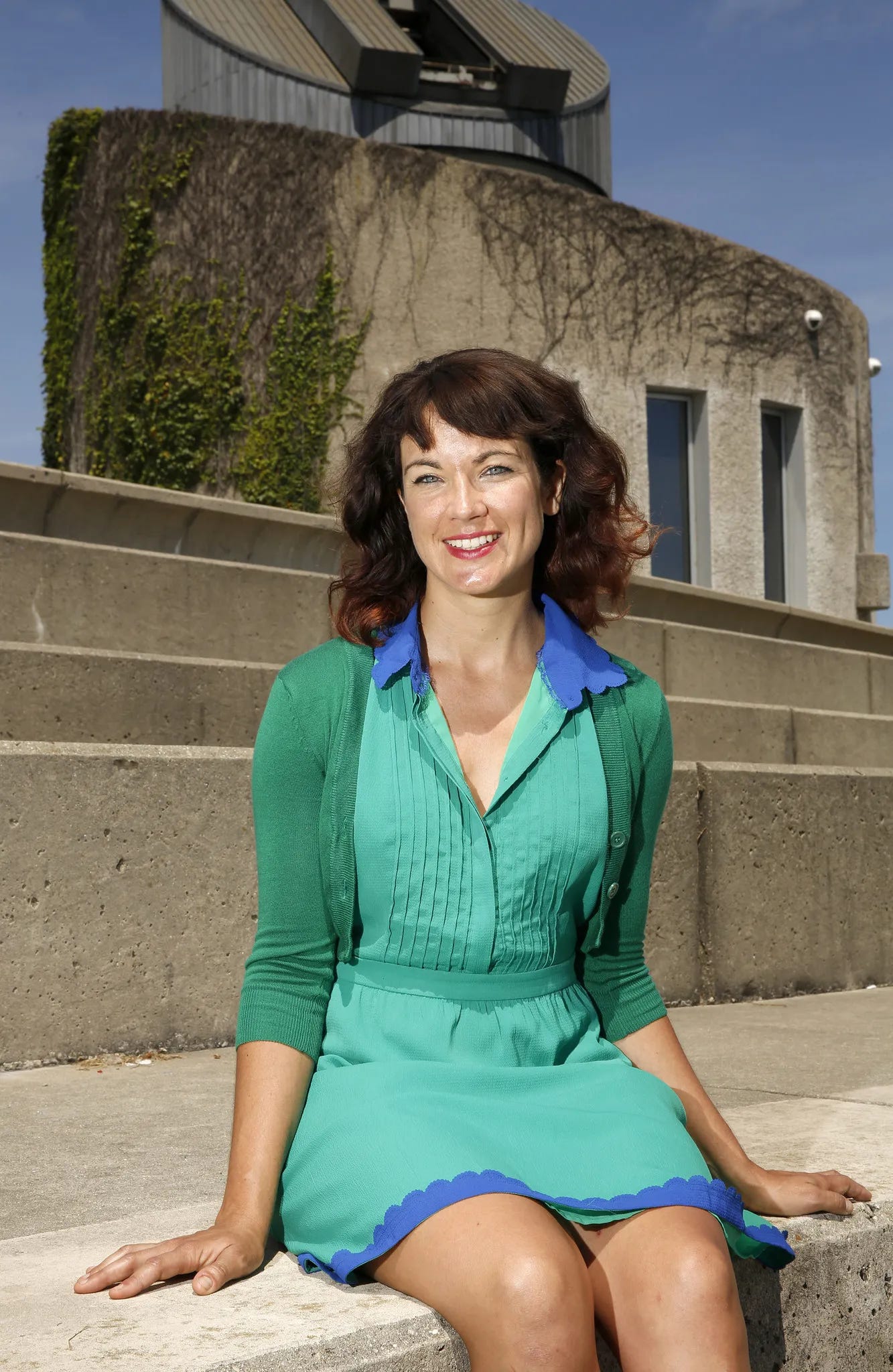
(Dr. Lucianne Walkowicz, astrophysicist and artist. Identifies as non-binary)
In Lo and Behold: Reveries of the Connected World, the first sequence is at UCLA, where the first ARPANET messages were sent to Stanford Research Institute, and computer scientist Leonard Kleinrock acts as a museum curator, showing us the sacred CPU that still stands, a sold metal box as tall as an NBA player. Kleinrock scribbles wild, highfalutin’ Shannon-like equations to show how Internet traffic has increased a billion-fold. If every message in the world from just one day was encoded on compact discs, they would stack up to Mars and back, or some dizzying, unfathomable (hyperobject-like) way. Herzog’s mordant sense of humor carries throughout the film. He juxtaposes a short interview with Space X’s Musk, who wants to go to Mars (Herzog says he does, too), with Dr. Lucianne Walkowicz of the Adler Planetarium in Chicago, who says the discourse about relocating to Mars “in case” something really bad happens on Gaia, misses the point. Herzog juxtaposes short sequences between Walkowicz and Musk, and after she makes an unassailable point, Herzog cuts to Musk just sitting there, looking at the camera, not saying anything. Perhaps this was footage of Musk while they were getting lighting right, but this is a powerful way for the editor/filmmaker to make their point. It looks like Musk has no rejoinder to the (beautiful and smart) astrophysicist. I think Musk would argue with her; I think Herzog thought she was right, and so uses this rhetorical method of aposiopesis.
It was interesting to see Danny Hillis talk, from what looked like a room in his massive house in Berkeley. My friend once interviewed him there. Ted Nelson, who coined the term “hypertext” in 1963, shows up to talk. He’s been lauded by Jaron Lanier as a visionary whose ideas didn’t catch on, probably because in Nelson’s architecture, individual creators would get paid for their work instead of platform owners. There he is, talking at his houseboat at Sausalito, where Alan Watts lived and where the Houseboat Summit took place. Impish, audacious physicist Lawrence Krauss shows up as a talking head who speculates but refuses to “predict” how things will go. There is a family sitting at their dinner table: someone had taken pictures of their daughter who had been in an auto accident and decapitated: people sent them anonymous emails with the pics, with vile messages attached, and…why? There are people who live in a remote area of West Virginia where there is no EMF due to a special telescope that detects frequencies; people who get sick due to EMF flock there, not being able to live anywhere else. Herzog showcases computer wizards who develop robots that can play soccer and learn and get better and better. He talks to biochemistry-interested computer scientists who developed a game for any citizen scientist to play in order to crowdsource the intricate ways protein molecules can fold, which seems now one of the best applications of AI. And, to my delight, famed hacker Kevin Mitnick shows up, still bragging about some of his exploits.
While Herzog’s film appeared in 2016, it, like Daub’s book, feels dated to me. And I think it’s due to the logarithmic acceleration of information, often written about by Robert Anton Wilson, Ray Kurzweil and many others, largely underwritten by Moore’s Law, in which omniephemeralization holds sway: integrated circuits will become smaller, faster and more efficient, roughly doubling in computational power every 18 months to two years. What thinkers predict about the social effects of this is diverse. Wilson thought it just makes everything and everyone crazier. He thought that around the year 2000. Hold on tight, volks. This may get far bumpier than we can imagine.
I saw Lutz Dammbeck’s little documentary The Net shortly after it came out 22 years ago. I re-watched this past year, and in some ways, it oddly seems more current that Daub’s book or Herzog’s wonderful documentary. Why? Because the German filmmakers don’t seem to be preoccupied with any ideas current right now, but at the turn of the century they took cameras to San Francisco, Los Angeles, New York and just asked questions. Here’s John Brockman, pre-Jeffrey Epstein news, talking about as arrogantly as he sounds in the prefaces to his books of interviews and essays by his “Third Culture” writers. Here’s Stewart Brand, who also seems a bit too swaggerly, but in his own way. He’s on a houseboat in Sausalito talking about his truly marvelous life and background. Here’s Kesey, here’s Leary. Etc, etc, etc.
Just my own weirdness, but the section, filmed somewhere in a house that looked like it was deep in the Santa Cruz mountains, there is Heinz von Foerster holding forth about reality and possibility in Wittgenstein, mathematics, constructivism, science/schizophrenia/schism, and a couple other subjects. Very elderly, speaking German (with subtitles), he seems like a good model for any “Mad Scientist” figure you’d want to envision for your science fiction novel. (As of this writing, here’s the segment; I’m hesitant to link to YouTube videos, because of my old blog and all the dead links, but this must be seen.) I find Heinz a thrill. The filmmakers caught von Foerster just before reached thermodynamic equilibrium at age 90, in 2002.
The through-line is Dammbeck’s correspondence with one Theodore Kaczynski, and why he did what he did. Dammbeck seems in some measure sympathetic to Ted’s philosophy. All these interviews with counterculture, computer scientist and Internet luminaries are intercut with snippets from the correspondence. Kaczynski was at Harvard, a brilliant kid with IQ off the charts, who was admitted as a poor kid from Wisconsin with really good grades. And…we can’t help but think something really bad happened to him at Harvard when he fell under the sway of the Department of Social Relations, headed by ex-OSS and professor Henry Murray. 2
After being fed-up with the scene as a professor of Mathematics at Berkeley (if Pynchon had been accepted when he wanted to go there and study math, he might have studied under Kaczynski), Ted dropped out, and armed with one of Stewart Brand’s Whole Earth Catalogs which showed you how to build your own cabin in the woods…
I came away from my second, twenty-years later viewing of The Net, thinking Kaczynski had a point. But, as the Republican party now says openly about Hitler: right idea, wrong way to go about it. And Kaczynski’s ideas now drive extreme environmentalism and it seems to me that ship has sailed. The Nazi ship hasn’t sailed.
I really don’t know what to make of the hyperobject Internet, and the more I read (and watch documentaries), the less I feel I understand.
And, as odd as this sounds, I enjoy this feeling.
I’ve been heavily influenced by Lanier’s arguments in You Are Not A Gadget (2010; Who Owns The Future? (2013); Dawn of the New Everything (2017); Ten Arguments For Deleting Your Social Media Accounts Right Now (2018); and There Is No A.I. (2023).
I recommend having a look-see inside Alston Chase’s Harvard and the Unabomber: The Education of an American Terrorist. I disagree with a lot of Chase’s social thought, but the book seems ultra-compelling when we look at the case of Kaczynski. Timothy Leary was at Harvard, with Murray his boss. Leary fully informed those who wanted to explore their mind with psychedelic drugs while Murray and his “study” often did not: Kaczynski would have had no idea what was happened to him, or why. And Murray died a stalwart fellow, well-spoken of. While Leary went to prison for objectionable ideas and a small amount of cannabis. There are times when just pondering this makes me feel insane. Or rather: more insane than I usually feel.
Terrific post. I found myself thinking about you, internet, and social media recently. Drummer Jack DeJohnette just died, and I learned about it on Facebook half a day before news of his death showed up when I googled his name. No one I see in the flesh cares much about jazz, but it has warmed my heart to see all the tributes to him on Facebook. I know many people consider Facebook evil, but I find it useful.
Yeah there is an odd enjoyment to be had in living in this science fictional universe. Perhaps it's because we are missing the biggest picture - no way to grok the whole of the hyperobject and then be coherent about it.
I first heard of the hyperobject via a respected Buddhist teacher on Twitter who soon after started heavily promoting Bitcoin. I pointed out to him that I thought it was really only good for criminal enterprises and he blocked me. Wisdom traditions aside, if I had sunk all my wealth into Bitcoin at that time I'd be fucking rich now.
The documentary edits you described reminds me of F for Fake... the sequence of edits with pauses leading to "Of couse he signed the paintings."