James Joyce and Espionage
Blurry aspects of literary Modernism and the spy game

With the rise of mass media and literacy in the first half of the 20th century, the disparity between utopian feelings around 1900 and the Great War only 14 years later, followed by fascism, another world war, the Bomb…we also became very aware of espionage. This will be the first of a series of essays on the topic of writers and artists and the security state. There’s something about imaginative writers and the craft and game of intelligence that has them overlapping in so many strange ways…
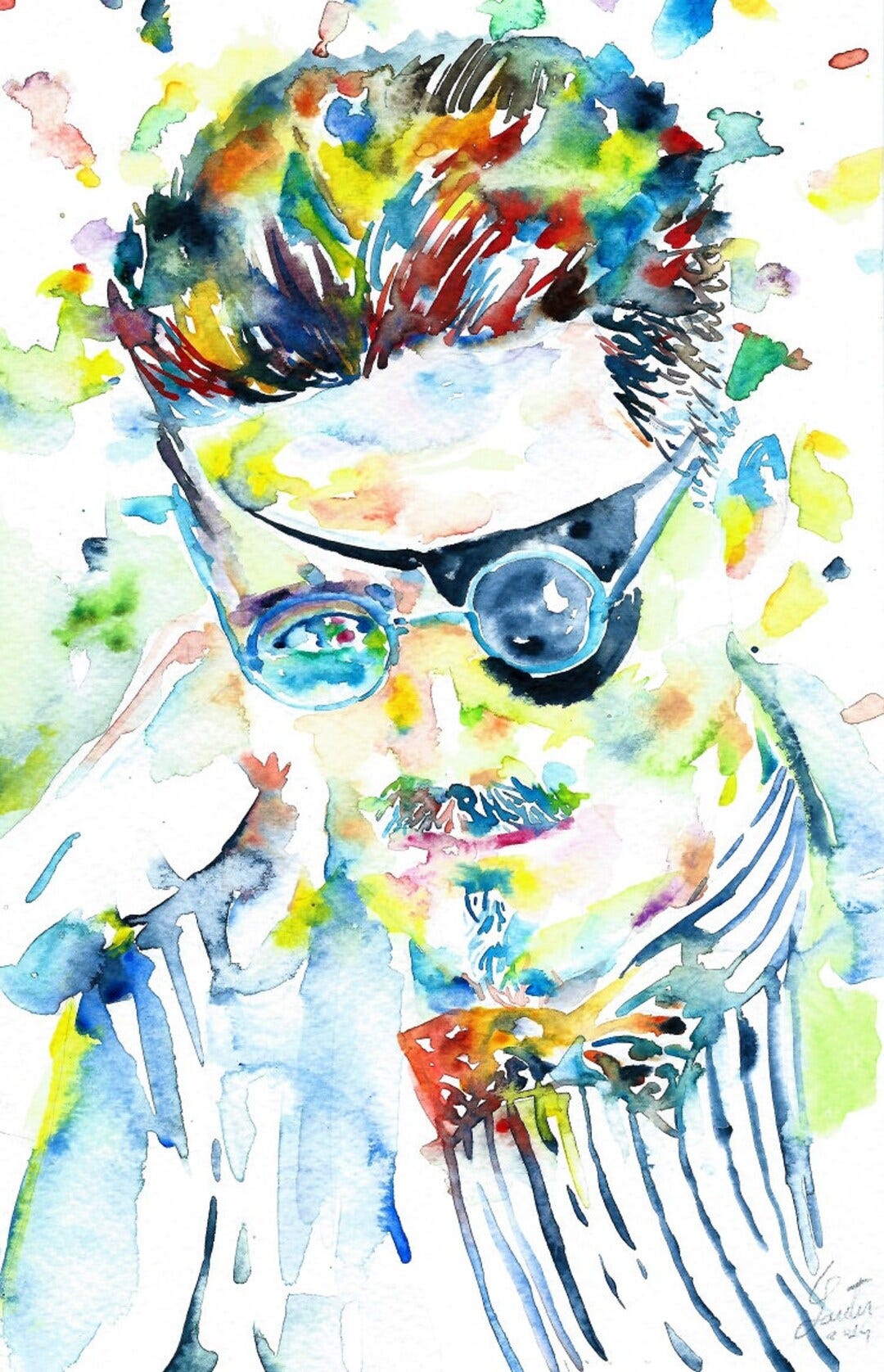
(artist unknown)
Anarchist Bombings in the US
United States, May Day, 1919: mail bombs sent by anarchists to prominent government agents explode. The following month: ten bombs explode in New York, Cleveland, Milwaukee and San Francisco. In DC, a man carrying a case to the attorney general’s house trips and a bomb explodes in the yard. Glass everywhere. Later police find what was left of the bomber’s head on the roof of a three-story mansion a block away. This is linked by authorities to Italian anarchist Luigi Galleani, who was quickly deported. Attorney General J. Mitchell Palmer amasses a security force four times larger than what is was during the Great War. The enemy: Reds. Bolsheviks, communists, weirdo bohemians and free-thinkers or anyone who seemed like they may be one. The infamous Palmer Red Raids ensued. A new, very small bureau in DC, the General Intelligence Division - soon to become the FBI - helps to suss out writers and publishers, files, books, magazines, newspapers, anything that sniffed of “radical literature.” A very small avant literary magazine, The Little Review, gets busted. It’s run by two arty lesbians who were attracted to Gurdjieff, Margaret Anderson and Jane Heap. They had been printing chapters of James Joyce’s upcoming novel, Ulysses. It was the only platform for Joyce’s book in the US. Now Joyce had a file at the nascent FBI.1
Unabomber
As Theodore Kaczynski’s bombs increasingly did more damage, the FBI was stymied trying to figure out who this guy was. Kaczynski was toying with them: inserting false leads, wearing elaborate disguises, taking long bus trips to mail his bombs from disparate locations, he even found hairs in public urinals and inserted them into his packages to throw forensics off the trail. Kaczynski also teased the FBI with wordplay and they didn’t know it for the longest time. Let’s look at how he used the word “wood.”
His bombs came in wooden boxes. His third victim was named Percy Wood, who lived in Lake Forest. The tenth victim lived in Ann Arbor. His 16th victim worked for the Forestry Service, and was mailed from Oakland, California. The sixth bomb was sent with the name of a real Brigham Young professor, Leroy Wood Bearnson. A writer at the San Francisco Chronicle, Jerry Roberts, received a letter from the Unabomber, who signed himself “Isaac Wood” of 549 Wood Street, Woodlake, CA. The wildest example, to me, is when the New York Times received a letter from Ted K in the early summer of 1993, which provided a social security number: 553-25-4394 as a way to prove it’s really him if he writes again in the future. Of course the data base for social security was consulted: this number was linked to an inmate at Pelican Bay prison in California. When officials approached the inmate, he knew nothing, of course.
But on his forearm there was a tattoo: PURE WOOD. I still can’t figure out how Kaczynski pulled this off.
Kaczynski, a former Prof of Mathematics at Berkeley, who wrote his thesis on “Boundary Functions” (don’t ask me!), knew Nordic and English language histories. In 1995, William Monahan of the New York Press, figured out that the Unabomber was using Old English: “wood” in its earliest usages, meant, “the sense of being out of one’s mind, insane, lunatic.” In Chaucer, when people “go wood” it’s because they’ve tricked. “Wood” was used when someone was bested by an intellectual superior. Monahan explained to the FBI and anyone else who would listen, the “going wood” was a triple entendre: angry at being tricked, numbness from trauma, and getting an erection.
And that was just part of the wordplay, Monahan suggested. For example, the package containing the bomb that killed Thomas J. Mosser of New Jersey listed a fictitious name, “H.C. Wickel,” as the sender. In old English, the word '“wicker” means wood. “H.C. Earwicker” is a ubiquitous character in James Joyce’s Finnegans Wake, who sometimes assumes the identity of the Norse god Woden.2
Kaczynski had signed some missives and his manifesto “FC.” It took awhile to figure out what this meant. It meant “Freedom Club” and it was taken from one of Kaczynski’s favorite novels, Joseph Conrad’s The Secret Agent.
Mail bombings, espionage, counter-intel, artists, false leads, intellectuals, and codes.
No Such Thing As Bad Publicity?
In a September 1920 letter to his brother Stanislaus, James Joyce wrote that there had been “reports” of himself as a spy in Dublin for the Austrians, as a spy in Zurich for the British or Sinn Fein, that his Ulysses was a pre-arranged German code, and that he was a cocaine addict. Sometimes I think Joyce was an all-timer at starting whispering rumors about himself. I suspect he was fascinated by how rumor worked, which was a lot like a virus.
Other rumors he’d heard about himself: he founded Dadaism, was a bolshevik propagandist, and “the cavalier servant of the Duch—--of M—--, Mme M—-R——M—-, a princ—de X——, Mrs T-n-T A—- and the dowager empress of China.”3 A few months later his prime benefactor, Harriet Shaw Weaver, wrote to express concern over Joyce’s excessive drinking. Apparently she’d heard stories from Robert McAlmon and Ezra Pound. Joyce’s reply to Weaver, dated June 24, 1921, is a study in disinformation between a writer and his sponsor: Joyce denies much while relaying other scandalous rumors about himself, which he denies, while also admitting to being and doing the kinds of things that Artists must do. Joyce scholar Richard Ellmann writes that Joyce “countered legend with fact and fact with legend.”4
Sylvia Beach reminisces about hanging out with Joyce in Paris:
He told me how he had got out of Trieste when the war came. It had been a narrow escape. The Austrians were about to arrest him as a spy, but a friend, Baron Ralli, obtained a visa just in time to get his family out of the country. They had managed to reach Zurich, and had stayed there till the end of the war.5
We wonder how many variations on this story Joyce told.
As many Joyceans observe, Joyce inserted his own fears and fetishes, dreams and obsessions in Leopold Bloom and HCE, (not to mention the antics of the Gracehoper-writer-artist layabout Shem the Penman) albeit exaggerated much of the time. One really doesn’t know what’s really true and to what degree, or how exaggerated his own weirdness was in these characters. Quite a lot of this strikes me as Joyce’s antic humor, but what do I know? It also further serves to illustrate Joyce’s understanding of the theory of relativity on a social or human scale.
This is all within a subset of difficulties in already notoriously difficult texts. Scholar Mark David Kaufman notes about the rumors Joyce recounted around being an alleged spy, and Ulysses: “The image of Ulysses as a book that seems to be hiding something, a book that may or may not be treacherous, has had a bizarre afterlife in popular culture. In The Manchurian Candidate (1962), Frank Sinatra’s brainwashed character owns a copy of Ulysses. Similarly, in Robert De Niro’s CIA film, The Good Shepherd, a KGB double agent hides his real identity papers in the binding of Joyce’s novel.”6
Claire Culleton traces “difficult” writers like Joyce, Woolf, Elliot, Pound to a general feeling, articulated by Llewelyn Powys in article in New Masses, in January 1927: “The average man would gladly kill artists for sport, for like fleas and bugs and lice, they disturb his sleep.” Culleton thinks this aptly describes the conscious orientation of J. Edgar Hoover (who had to cover for his own homosexuality). For Hoover, the average Joe and Josephine America felt anxiety over the writings and paintings of these weirdos, and they had to be reigned in. Hoover wrote much intelligence lit-crit, which is perennially the most clueless in the lit-crit genre. Conservative guard dogs speaking on behalf of an insensible horde: Culleton thinks this ironically privileged the High Modernists, and pushed intellectual modernism, “driven by its aesthetic of complexity.”7
In literature, this notion of using difficulty in an effort to create new styles and forms is one thing, but evasions, plausible deniabilities, and self-mythologizing of the artist could be a form of defensive esotericism. The writer feels that he might be persecuted for what he writes, so he utilizes smoke and mirrors to obfuscate, and only the initiates are clued-in. In Arthur Melzer’s book-long attempt to flesh out Leo Strauss’s theory of esotericism in Strauss’s Persecution and the Art of Writing, Melzer writes that a writer may write esoterically to avoid two evils: “either some harm that society may do the writer (persecution), or some harm that the writer might do society (‘dangerous truths’), or both.”8 Obviously, Ulysses was banned in the United States for 11 years after its release in Paris. Despite the difficulties, certain people quickly sussed out the naughty bits (that they could detect), and it was enough. After thirty-odd years of reading all things Joyce, I feel I have less of an understanding of him than when I started. Joyce himself was an Enigma Machine!
Ed Sanders: Writer as Intelligence-Gatherer
Classicist but also a member of the proto-punk band The Fugs, Sanders’s slim pamphlet, Investigative Poetry, advocates for writers to report journalistically in the form of poetry or verse, like the ancients did. He gives many examples. He also lists numerous writers who were persecuted by the State for their writing. Sanders presents a 180 degree mirror image of the spook: the poet/artist/countercultural gathering of intelligence and corroborating reports, including techniques (Sanders urges us to open up our own files on any subject that interests us, including our friends), and advice for dealing with dangerous, difficult people. His advocation of studying one’s own notes to glean “data clusters” seems ultra creative and revelatory. The story on p.32 about Sam Giancana, Sinatra, Las Vegas and the CIA is a good example of what Sanders was up to. Sanders’s biggest influence was Charles Olson, who had strong ties to the work of Ezra Pound, who was the idol of…the head of CIA counterintelligence, James Jesus Angleton, who had lunch often with his friend Kim Philby while not knowing Philby was a double-agent. When Pound was detained by Allied troops in Italy, his Pisan Cantos were suspected of being a secret code.9 Sanders was also heavily influenced by Allen Ginsberg, who similarly kept files on hundreds of topics, and once actually had lunch with Angleton.10
Investigative Poetry has been a major influence on the Overweening Generalist.
Did Joyce Know and Use Classic Ciphers and Codes?
The answer appears to be yes. In the “Scylla and Charybdis” episode in Ulysses, Stephen argues about who the “real” Shakespeare was. Who actually wrote Shakespeare? And Joyce was well aware of a best-selling book by Ignatius Donnelly and the idea that Francis Bacon wrote Shakespeare.11 The sheer level and amount of fun Joyce had with Bacon-Shakespeare has inspired thousands of pages by Joyce scholars. Bacon had actually spelled out a biliteral cipher in his Of the Advancement of Learning, Book VI, chapter 1. This cipher was what fired Donnelly up in his hammy pursuit of the “real” Bard: Bacon.
Two of the most famous and sophisticated inventors of ciphers, Sir Francis Beaufort (d.1857), and Charles Wheatstone, who attributed his cipher to Baron Playfair (d.1898) may have been used by Joyce; all three names appear in Finnegans Wake:
The optophone which optophanes. List! Wheatstone’s magic lyer. (FW, p.13)
Hark to his wily geeses goosling by, and playfair, lady! (FW, p.233)
in the end, the deary, soldpowder and all, the beautfour sisters (FW, p.393)
till they were bullbeadle black and bufeteer blue…(FW, p.511)
in blue and buff of Beaufort the hunt shall make (FW, p.567)
The problem here is that these ciphers work in a long enciphered text, and Finnegans Wake is not such a thing. Joyce scholar James Atherton insisted that Joyce acknowledged all of his influences by hiding them in his texts, and it seems safe to guess that Joyce enjoyed the ciphers of Beaufort/Wheatstone/Playfair within the context of the Bacon-Shakespeare stuff, but what about this passage in FW?:
I should like to euphonise that. It sounds an isochronism. Secret speech Hazelton and obviously disemvowelled. But it is good laylaw too. We may take those well-meant kicks for free granted, though ultra vires, void and, in fact, unnecessarily so. Happily you were not quite successful in the process verbal whereby you would sublimate your blepharospasmockical suppressions, it seems? (FW, p.515)
This is Shaun, the frustrated postman, conservative, the Ondt to Shem’s Gracehoper, and feeling like an intelligence agent here, calling out the text, probably Finnegans Wake itself. “Isochronism” means appearing at regular intervals, which is crucial in a good substitution cipher. “Secret speech” seems obvious. “Disemvowelled” is a very common way to code: leave out the vowels. (Or: lv t th vwls) Joyce actually uses this tool in discussing what’s in Bloom’s drawer at his house on Eccles Street. “Sublimate” also seems quite obvious in this con-text. “Bepharospasm” is a spasm of winking, which we see in film after film and TV, when a character is trying to stay quiet and signal to another to “go along with this.” Or: whatever I seem to be saying just now? Don’t believe it!12
Where might Joyce have caught on to the cryptographer’s bug? One guess: J.F. Byrne, Joyce’s good friend in college. John Francis Byrne, AKA “Cranley” in A Portrait of the Artist As A Young Man.
John Francis Byrne (1879-1960)
In A Portrait of the Artist, the budding consciousness of Stephen Dedalus is trying to articulate his own ideas about aesthetics, and he tells these to his sympathetic friend, Cranley. Cranley is based on Joyce’s friend J.F. Byrne. They had known each other for a long time, but became close while both were at University College, Dublin. Byrne had actually lived at 7 Eccles Street, the address of Molly and Leopold Bloom in Ulysses, from 1908-1910, with two cousins, and one night in 1909, when Joyce had returned to Dublin they went out partying and came back to Byrne’s house and Byrne had forgotten the key in another pair of pants, so he climbed over the wall…the same thing Bloom does at the end of the day in Ulysses. Byrne exiled himself from Dublin for New York in 1910 and became a journalist and worked as a financial editor at the Daily News Record in NY from 1929-1933 under the pseudonym J.F. Renby. But what’s most interesting about Byrne here: he invented a “chaocipher” made from a cigar box, a few bits of string and odds and ends. He claimed it produced ciphers that were uncrackable unless the receiver had the key.
In a chapter on heterogenous cryptographers, David Kahn relates Byrne’s gambit: he came up with the “chaocipher” in 1918, convincing himself it would produce peace and perfect security between confidants. His cousin thought he’d win a Nobel Peace Prize for it. He demonstrated it to top cryptographic men at the Signal Corps. They passed. The State Department said thanks but no thanks, that their ciphers were “adequate to its needs.” Kahn says Byrne was right to call this “a paragon of smugness.” In 1938 Byrne showed his chaocipher to the Navy and AT&T, who passed on a deal. Byrne continued to have faith in his invention (you’ll never read “Cranley” the same way you did) and in the last chapter of his book The Silent Years: An Autobiography With Memoirs of James Joyce and Our Ireland he inserted a message in Chaocipher at the end, openly challenging anyone to crack it, with the prize being $5000 or the royalties for his book after the first three months. Byrne challenged the New York Cipher Society, the American Cryptogram Association, and the founder of cybernetics, Norbert Wiener. No one cracked it, and Byrne died in 1960. Kahn surmises that the reason the Chaocipher never caught on was that, while it had merits, it was probably not of practical use.13
Macintosh
Who is the man in the macintosh who keeps appearing all over Dublin, June 16, 1904? He first appears at Paddy Dignam’s funeral. “Now who is that lankylooking galoot over there in the macintosh?,” Bloom wonders. Then macintosh disappears. In the “Wandering Rocks” episode he appears: “A pedestrian in a brown macintosh, eating dry bread, passed swiftly and unscathed across the viceroy’s path.” Etc. he keeps reappearing then disappearing. We all have our hypotheses and I will not add to the more than five thousand essays trying to convince you I have the best guess, but I just think he seems to be a spy, and he also seems to be Joyce himself, presaging Alfred Hitchcock showing up in his own work, the Author himself inside the work, saying to us, I’m here. And he’s there to gather intel. On the human condition of his characters and us.
Who do you think Macintosh is, and why?
The Most Dangerous Book: The Battle for James Joyce’s Ulysses, Kevin Birmingham, pp.154-156, (2014)
Harvard and the Unabomber: The Education of an American Terrorist, Alston Chase, pp.42-44, (2003)
James Joyce, Richard Ellmann, first revision, p. 509, (1959-1982)
Ellmann, pp.509-512; this same letter is printed in the one-volume Joyce: Selected Letters, edited by Ellmann, pp.281-284. Ellmann himself was in the OSS under Yale professor Norman Holmes Pearson, but Ellmann seems to have used his time there to go to Ireland to visit Yeats’s widow and look at his manuscripts. Pearson’s secretary in the OSS was Ezra Pound’s ex-girlfriend HD’s daughter. Pearson recruited his “number two” in the OSS, James Jesus Angleton, to be head counterintelligence at the new CIA. There will never be a shortage of wild and weird daisy chains when one begins researching literature, espionage, secret societies, and the occult. “Espionage, political intrigue, and the occult tend to come together in secret societies.” - Dr. Richard B. Spencer, Emeritus professor of History at U. of Idaho, in lecture series The Real History of Secret Societies (Teaching Company). About secret societies and the occult: Joyce was very familiar with the material of the Golden Dawn, the same that had as members William Butler Yeats and Aleister Crowley. Joyce knew their literature - kabbalah, tarot, ritual, many forms of esotericism - but preferred to keep his own aesthetics of applied Aquinas. As you well know.
Shakespeare and Company, Sylvia Beach, new edition with introduction by James Laughlin, p.38 (1956/1991)
“Clever, Very,” Mark David Kaufman, James Joyce Quarterly, Nov. 9, 2020
Joyce and the G-Men: J. Edgar Hoover’s Manipulation of Modernism, Claire A. Culleton, pp.65-68 (2004)
Philosophy Between the Lines: The Lost History of Esoteric Writing, Arthur M. Melzer, p.4 (2014) I used Melzer’s thesis for much of my thinking about Giambattista Vico’s protective esotericism in “Notes on Vico, Wilson, Language, and Class Warfare,” in TSOG: Tsarist Occupation Government, Robert Anton Wilson, pp. 245-293. Vico was a heavy influence on Joyce’s Finnegans Wake.
Pound had to explain himself to the authorities about his poetry written in prison: “The Cantos contain nothing in the nature of cipher or intended obscurity. The present Cantos do, naturally, contain a number of allusions and recalls, to matter in the earlier 71 cantos already published, and many of these cannot be made clear to readers unacquainted wth the earlier parts of the poem […] The Chinese ideograms are mainly translated, or commented in the english text. At any rate they contain nothing seditious…”: this defense by Pound was first published in the Paris Review, vol.7 no. 28, Summer-Fall 1962. I found it in A Guide To The Cantos of Ezra Pound, William Cookson, pp.xxvi-xxvii. The Paris Review was funded by the CIA. Pound’s Cantos seem at least the equal to Joyce’s difficult texts, and were therefore suspect by intelligence agencies. How can one know an erudite, experimental writer isn’t trying to code secret messages to aid someone else? Pound was instrumental in the discovery of James Joyce as an important writer, and in getting Joyce funded so he could write his texts.
Sanders wrote a history of the United States: America: A History in Verse, 1900-1939; another volume covering 1940-1961; a third covers 1962-1970, and there’s a separate volume devoted just to the year 1968. He also wrote books in verse about Chekhov and Ginsberg. OSS’s Norman Holmes Pearson, who declined joining the new CIA in favor of returning to his professorship at Yale, was friends with Ed Sanders. Pearson also seems to have continued on as a teacher of counterintelligence officers. “In fact, in his responses to a 1964 questionnaire about Fuck You: A Magazine of the Arts, Sanders said that the magazine was funded in part by ‘a leading Ezra Pound scholar of Yale.’” This was in fact, Pearson. See Code Name Puritan: Norman Holmes Pearson at the Nexus of Poetry, Espionage, and American Power, by Greg Barnhisel, pp.304-305 (2024)
The Great Cryptogram: Francis Bacon’s Cipher in the So-Called Shakespeare Plays, 1887.
see “Joyce and Cryptology: Some Speculations,” Hugh B. Staples, James Joyce Quarterly, vol.2, no, 3, Spring 1965, pp.167-173
The Codebreakers, David Kahn, pp.766-768 (1967/1996)
‘There will never be a shortage of wild and weird daisy chains when one begins researching literature, espionage, secret societies, and the occult.’
By all means, feel free to speculate further in the future, to the delight of our astonished minds.
And thanks for the Investigative Poetry recommendation. I love adding more books to my never ending pile of to-read after going through one of your essays.
Although I tend to favor the idea that Mackintosh stands for Joyce himself, I seem to recall RAW seeing it as well as an indication that it is not possible to solve all the puzzles of Ulysses, some mysteries will always remain. I might have gotten that from the RAW Explains Everything talk, but don’t take my word for it.
Scintillating semiotics! Delivered with impeccably precise timing!
Having just pawed through Ed Sanders personal archives I can attest to his wonderful diligence in preserving delightful artifacts.
It's kind of funny because RAW stamped a lot of his correspondence with a warning that it may be an "important historical document," a self-fulfilling prophesy now realized, as I accessed the pages within the Princeton Library Special Collections Dept, after washing my hands, locking away my possessions, agreeing to all sorts of rules and restrictions, under the watchful eye of an attendant, and several security cameras.
I'm willing to concede to some woodsy cleverness on Kaczynski's part, though remain profoundly unimpressed by his manifesto!
I'm quite partial to RAW's solution that the man in the brown mackintosh is Simon Moon :)))
https://rawilsonfans.org/dirty-socks-and-denture-breath/
I created an encoded art piece called "The Tanha Tablet" back in my art school days, as part of a print making class.
Seven 12" x 12" carved linoleum print blocks, with a very simple embedded code, so simple, I theorized in the folly of youth, that your unconscious "mind" could decode the message, even if you were not consciously aware of it, creating a subliminal messaging effect.
I no longer think that, but I sold it really well in the room when I was presenting it, and had the class and teacher convinced!
https://weirdoverse.com/the-tanha-tablet/
Also! Finnegans Wake gets a shout out in Vince Gilligan's new (Amazing!) show "Pluribus."
VG, who previously worked on The X-Files and created Breaking Bad and Better Call Saul.
Currently under moderate suspicion of being a RAW fan because of his usage of the character name "Saul Goodman."