RAW's Publishers, Part 2
Notes on And/Or, Krassner, Ginzburg, Roseman, and Fass. Part 3 will address Hyatt/New Falcon and a few loose ends

RAW and His Publishers
In our last episode, the OG was going on about Wilson’s (ahem) unfavorable attitude toward publishers and editors, and “writing as business” in general. And while Pound had his great champion in James Laughlin, RAW had a few publishers who were champions of his work, too. But small publishers seem often colorful characters…
Aside from Playboy Press, Wilson published his Schrödinger’s Cat trilogy with Dell, a major NY publisher. All the rest of his books were with small, marginal publishers, except his “conspiracy encyclopedia,” Everything Is Under Control, which was with Harper/Collins and he said somewhere that their lawyers went over every line to make sure they couldn’t get sued, which was a drag. He had very bad luck with the publishers for his projected five-part Historical Illuminatus Chronicles, which I will go into at some other time, but what’s more striking to me is that when you publish with non-establishment publishers you tend to run into some very interesting characters.
Playboy Press also published his Book of Forbidden Words and The Book of the Breast; of the former RAW complained that it was a:
disaster and again proved my naivete about he publishing industry. The book was not my idea but that of an editor at Playboy Press, who asked me if I could write a history of foul language. I said sure, I could, since I knew a lot about linguistic history and also knew how to do research; we signed a contract and I went ahead — quickly producing a book of high erudition and (I think) some wit. It turned out that this was not what was wanted. The erudition and the linguistic history were excised, along with much of the wit, and in his hurry to turn my work into a more commercial production, the editor in many sections replaced correct grammar and syntax with the kind of pidgin English generally only encountered in TV advertisements.1
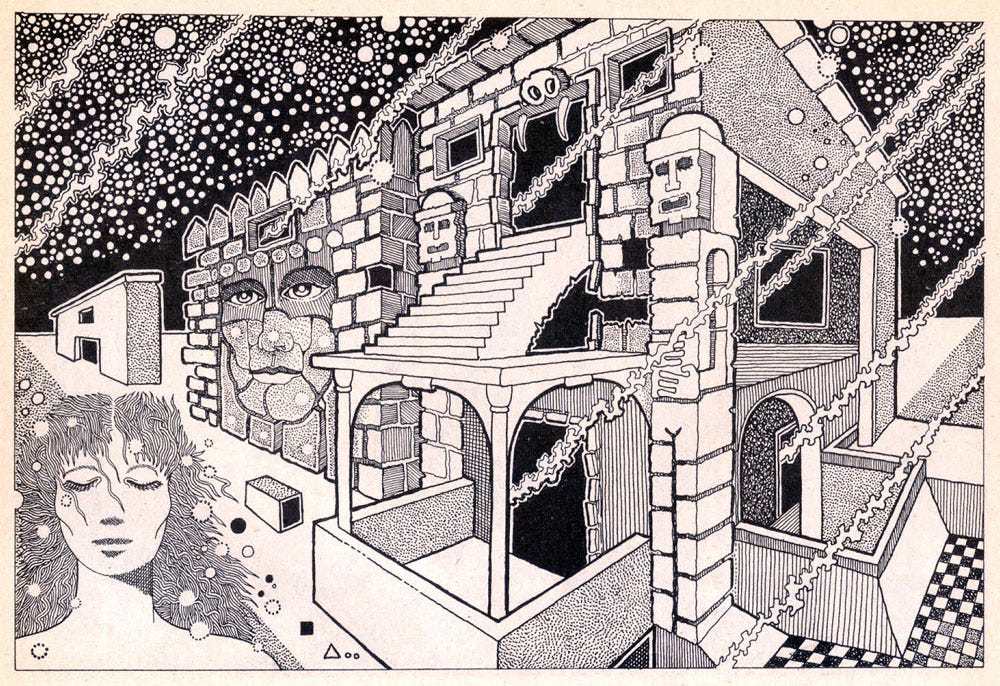
(artwork by John Thompson, who worked with Sebastian Orfali at And/Or Press)
And/Or and Sebastian Orfali
And/Or Press in Berkeley was founded by Sebastian Orfali, along with his brother John, and a psychedelic artist RAW thought was Blakean, John Thompson. They may have all been roommates in San Francisco and publishing for Last Gasp and/or an underground comix bookstore in North Beach, People’s Comix in the early 1970s. Sebastian, born Joseph Peter Orfali in Jerusalem, decided to start And-Or Press in 1974. Previously he earned a Master’s in Philosophy at U. of New Mexico, and he worked as a teaching assistant there before moving to the West Coast. Orfali was a daring publisher: Marijuana Grower’s Guide was banned in Canada and was used as a weed grower’s bible by growers in the Emerald Triangle, which received a huge boost when Reagan had the Mexican cannabis field sprayed with paraquat, which provided a strong impetus for cannabis horticulturists in Northern California to develop stronger, seedless weed for the domestic market. Orfali’s colleague Peter Beren says it sold more than 500,000 copies.2 Jay Kinney’s Young Lust comix were banned in England as too pornographic. Orfali appears to be a character in one of Bill Griffith’s “Zippy the Pinhead” strips; Orfali and Griffith probably knew each other from the early 1970s San Francisco scene.3 And/Or’s Holistic Health Handbook sold 800,000 copies in 1978, according to Peter Beren, who worked with Orfali. Orfali was really a trailblazer for books on drugs, and And/Or’s books were hot in head shops, which were gradually closed down under Reagan. I recall my own astonishment at seeing a fat book titled Psychedelics Encyclopedia, by Peter Stafford, on a used book store shelf, for around $10. This was a long time ago, when “psychedelics” were not written about in the mainstream at all. And I had no idea who And/Or were, and there were names like Jonathan Ott, Robert Anton Wilson, and Sasha Shulgin all over it, and I didn’t know who those people were at the time.
Orfali was probably influenced by Michael Horowitz’s burgeoning collection of books about drugs, which eventually merged with two (three, if you count Michael Aldrich) other collectors and named the Fitzhugh Ludlow Memorial Library. Orfali brought back into print a 1929 book titled Black Opium, by Claude Farrère (AKA Charles Bargone, 1876-1957), “featuring striking, exotic and evocative illustrations” by Alexander King. Orfali and Co. put out a facsimile edition of this book, the earlier Paris edition was highly sought after by collectors. Horowitz likened the prose style to James Joyce’s Dubliners. And/Or also graced the counterculture readership with another book of classic drug literature, Cocaine (1921), by Pitigrilli (AKA Italian journalist Dino Segrė), which appeared a year before Crowley’s Diary of a Drug Fiend, and, according to Horowitz’s partner William Dailey, captured “a vivid picture of the cocaine-crazed demimonde of the Parisian 1920s,” of which Stephen J. Gertz says is “an understatement in the extreme.”4
And/Or, over the eight years they operated, also put out books by RAW (most notably: Cosmic Trigger, Vol 1, now a counterculture classic), and books by Jacques Vallee, Colin Wilson, and David Wallechinsky5. Paul Krassner and Timothy Leary also had books put out by And/Or. Terence and Dennis McKenna’s Psilocybin: Magic Mushroom Grower’s Guide was (and probably still is) a best-seller in that genre. No one had seen anything like it: the brothers published under pseudonyms, O.T. Oss and O.N. Oeric6, with line drawings by Kat McKenna.
As much as RAW found to carp about many publishers, I’ve never seen a harsh word for Orfali, and RAW has a very wise alchemist character in his Historical Illuminatus series named “Abraham Orfali.” And/Or operated out of Berkeley, and, after what appears to be some sort of hostile takeover by a larger publishing consortium, morphed into Ronin Publishing, run by Orfali’s life partner, Beverly Potter.7 “He loved telling of being busted on the Ides of March by the border patrol in Truth or Consequences, New Mexico, for three pounds of pot,” Potter relates.8 His attorney got him off the rap, and later turned into a Buddhist priest.
The DEA at one point tried to obtain a list of And/Or/Ronin’s customers who bought the cannabis horticulture book in Arizona, and they sued back.
Orfali died at the age of 51, and it’s a horrible thing to read about: it seems to have started with teeth problems. Some dentist had inserted a small silver wire jacked into the root of one of his teeth, and this may have led to cancer of the mouth, and the gory, cascading ever-worse details are relayed by Bev Potter in a bizarre, maddening book I found in a used bookstore in Berkeley, Animal House On Acid: The Barrington Hall Saga: A Memoir, 2015.9 Barrington Hall was a notorious (insane!) student co-op near UC Berkeley, and Potter and Orfali lived next door to it. You’ve read about roommates from hell? The denizens of Barrington Hall terrorized the neighborhood and made me think, “I’d have moved out of there years ago!”10
Herb Roseman
RAW seems to have known Herbert C. Roseman through co-editing of The School of Living’s magazine Way Out. The School of Living was founded by Ralph Borsodi in 1928 and was one of the proto-hippie drop-out communal living sort of things, but it lasted. They were serious. They had a large library of anarchist (19th century America: “libertarian”) books of all sorts, and Wilson seems to have read that entire library.
After leaving the School for New Jersey and then ending up in Chicago as an editor for Playboy, RAW thought Roseman’s Revisionist Press would be the publisher of his book on Aleister Crowley, Do What Thou Wilt: An Introduction to Aleister Crowley. Gabriel Kennedy found RAW’s manuscript of this book in Harvard’s Houghton Library. It had been found by Harvard at Carl Willians Rare Books in London and bought in 2018. RAW had apparently written another book about Crowley titled Lion of Light, which appears to not be the version with the same title published by Hilaritas Press in 2023. Who knows where the original Lion of Light is?11
So, Roseman for some reason never put out Wilson’s book on his Revisionist Press, which appears to have been a subsidiary of Gordon Press. They appear to have put out a red hardcover version of the Discordian bible, Principia Discordia. Revisionist once had a Wikipedia page, now gone. There were (paranoid?) rumors that their catalog of conspicuously high-priced books was a front for the CIA and/or the FBI, to gather names of subversives interested in ideas about the controversial, esoteric and revisionist history and the like. Someone online has quoted Roseman, “I wish it was true about the CIA! We might have made more money.”12
What gets me is that RAW wrote this book on Crowley - what we read as Lion of Light (2023) - merely months after being introduced to Crowley and his difficult Modernist texts by Alan Watts. It’s one of the most insightful books ever written about Crowley, was written quickly, and is a perfect example of the virtuoso “quick study” that Wilson was. No doubt his many years of reading dense, difficult Modernist text by Joyce and Pound prepared him for Crowley. It’s a sort of reading that seems to be vanishing in 2026, a cultural reading scene that seems to be reverting to the days when only monks and priest actually read books and manuscripts for many hours of the day. That RAW sent this manuscript to Roseman, hoping to be paid at some point but seeming to forget about this text? There seems to be some missing information here.
My own copies of Proudhon’s General Idea of the Revolution13 and Benjamin Tucker’s Instead of a Book were put out by Gordon Press, but apparently Revisionist Press re-printed famous works by hardcore revisionist historians like Harry Elmer Barnes, who also were Holocaust revisionists. Gordon/Revisionist were a poorly run family publishing biz and they went kaput in 2001, sold to Run For Cover.14
Paul Krassner and Ralph Ginzburg
Krassner was one of the first to publish Wilson, in his The Realist, in 1959. They remained friends until Wilson’s death. A fearless writer and editor, Krassner was at a nexus with the renegade publisher Lyle Stuart15, who Krassner worked for while he was still in college, was friends with Ed Sanders, Ken Kesey and Leary, knew Mae Brussell, and also wrote for High Times. He turned Groucho Marx onto LSD.16 Before taking the stand for the trial of the Chicago Seven (or Eight), Krassner took acid and testified.17
Ralph Ginzburg hired RAW to write for FACT, and in 1964-1965 Wilson published at least ten well-researched, pull-no-punches investigative journalism and analyses of subjects such as advertising, atheism, free love, the National Enquirer, MAD magazine, the KKK, and William S. Burroughs.18
Ginzburg, another fearless publisher, put out four copies of eros in 1962, got arrested for publishing porn, took it all the way to the Supreme Court, lost, was sentenced to five years, and did eight months, which he writes about in Castrated: My Eight Months In Prison (1973). I admire Ginzburg, who I can’t help but mentally link to certain jewish radical publishers who seemed absolutely driven by both radical free speech, radical ideas, and money, probably roughly in that order. The list is long and I have much to say about these Jewish badasses, but will save it for another day. Krassner writes about a rift between Ginzburg and Lyle Stuart:
Stuart guided Ginzburg through the publishing of An Unhurried View of Erotica, “finding him a typesetter, a printer, a distributor, a mailing house - and when the Post Office seized Ginzburg’s mailing piece, Lyle sent attorney Martin Scheiman to Washington to obtain release of the mailing. One day Lyle was giving Ginzburg help on his ad campaign.
“I’m publishing a book by Albert Ellis called Sex without Guilt,” Lyle said. When you book some of your radio and TV things, could you suggest him as a fellow guest?”
“But the topic will be pornography.”
“Ellis is a pornography expert. He’s testified in many trials.”
“I can’t do that,” Ginzburg said. “What’s in it for me?”
Krassner ads: “Thus did Ralph Ginzburg make Lyle Stuart’s permanent shit list in a single bound.”19
Ginzburg put out The Housewife’s Handbook on Selective Promiscuity, which was written by “Rey Anthony” who was actually popular sexual technique writer Lillian Maxine Harrison AKA Maxine Savant AKA Maxine Sanini, and this book was part of the obscenity trial that got Ginzburg time in slam, but she was never prosecuted. I have not yet seen a copy of this book, although I will. One day.
FACT published, in September-October 1964 - just in time for the election - an article titled “The Unconscious of a Conservative: A Special Issue on the Mind of Barry Goldwater,” in which they - RAW was not involved - asked 1800 psychiatrists their opinion of Goldwater’s fitness to be POTUS. In their professional opinions, Goldwater was manifestly unfit. Goldwater sued Ginzburg for $1 million; he got $1 in compensatory damages and $75,000 in punitive damages. Ginzburg took another one on the chin. This basically bankrupted Ginzburg. I note this because it reminds me of my reading of the 27 psychiatrists, mental health profesisonals, and psychologists, who contributed to The Dangerous Case of Donald Trump and declared him a “clear and present danger” to the US, in 2017. Psychiatrists have a professional “duty to warn” which seems to clash with the precedent of the “Goldwater Rule,” which the American Psychiatric Association thought they violated. Anyway…what do these people know anyway, am I right? (cough)20
About Krassner, RAW wrote:
Paul Krassner’s iconoclastic journal, The Realist, has published more of my writings than any other American magazine, and there was a period in the last 1950s and early 1960s when I might have given up writing entirely if Paul had not gone on publishing my work. I think everybody in the “counterculture” owes a great debt to Paul Krassner, but I perhaps owe him more than anyone else.21
At this point, given the quotes from Wilson in Part 1, we must realize his problems with editors and publishers were more with…guys who wore ties and worked in skyscrapers in Manhattan? Because clearly, there were radical, progressive, fearless publishers who published RAW’s work…they just weren’t issuing stock, etc. It’s always more complex, isn’t it? Aye, I think so: delightfully, intriguingly so.
Myron Fass: Schlockmeister Extraordinaire
I recently watched a documentary about the early history of the Pacifica Radio station WBAI-New York, Radio Unnameable (2012 Lovelace and Wolfson), which was about Bob Fass, friend of Krassner, Sanders and the Yippies, and a legendary radio man in New York FM radio. Bob Fass was born in 1933 in Brooklyn. Schlockmeister Kingpin Myron Fass was born in 1926 in Brooklyn. I did searches for both, reading for over an hour to confirm what the Google search AI said: they were brothers. I couldn’t find anywhere where Bob talked about Myron or Myron mentioning Bob, or any of their friends or researchers pointing it out. I’m still in doubt, because so often AI has given me wrong answers, so if it’s true, I can see why neither talked about the other: Bob Fass was a progressive leftist while who knows what politics Myron was about, but there are stories of him brutally beating a writer or editor for one of his periodicals. RAW wrote an expose of his own work for Myron Fass that Krassner published in The Realist, “Anatomy of Schlock,”22 which starts out:
For three months, I have worked as an editor in the country’s leading schlock factory. My boss assured me that our schlock reached 30,000,000 Americans every month, and that, brethren, is a lion’s share of the schlock market. Let me define my terms. Schlock is the next level below kitsch. Kitsch is naive, maudlin, hokey, unsophisticated. Commercial folklore, so to speak […] Kitsch is “ I Found God When My Doctor Told Me I Had Cancer,” “Jackie Kennedy Tells Why She Will Not Re-Marry,” “Should Wives Enjoy Sex?”
Schlock, on the other hand, is brutal, lumpen-prole, aggressive, hairy; like carnival hot-dogs, so spicy you might vomit if you’re over-sensitive. Schlock is “He Beat His Grandmother to Death With Her Crutch,” “Love-Starved Arab Peasant Woman Raped Me Twenty Times,” “The Disease That Liz Caught From Dick.”
After FACT, Wilson found work at Fass Publications. Quite a leap!
He wrote astrology columns, just making stuff up and getting fan mail about how accurate he was. He edited “four girlie magazines simultaneously”23 and he made up captions for the soft-core porn photos of girls, writing they were scientists, stewardesses, or typists, who like peyote and read William S. Burroughs. My favorite tabloid title that RAW made up was “Mad Hunchback Sells Hunch To Butcher/Woman Poisoned By Hunchburger.”
Myron Fass had been influenced by Bill Gaines of Mad magazine, and so had Krassner, who knew Gaines and worked for him, and basically, started The Realist as a Mad magazine for grown-ups. Fass was influenced by Gaines in that the obscenity laws favored “magazines” over “comic books” and Gaines had published Mad as a magazine, not a comic, to evade the new Comics Code Authority. You can get away with more that way. And, my gawd, did he get away with a lot.24
Wilson never mentions Fass’s name nor the name of the magazines, for understandable reasons. Eventually Fass gave RAW reign over one of his Playboy knockoffs, Jaguar. Fass wanted RAW to make it not too schlock and not too egghead, so RAW “revamped my table of contents several times, making it more schlocky each time. I kept two non-schlock articles, a factual piece about Cuba, and an interview with with a prominent novelist, and tried to make the rest of the pieces come out both schlock and non-schlock simultaneously. This I did by giving them schlock titles but sophisticated insides, or, in one case, a sophisticated title with schlock insides.” Fass fired him anyway.25 RAW had published this exposé in The Realist under the pseudonym A. Nonymous Hack, but an editor at Playboy read it and was impressed, and he got hired there, the best paid job he ever had, editing the Playboy Forum with Robert Shea.26
Part 3 will be shorter, and include RAW on Falcon/New Falcon and a few further comments. Sorry for the length!
Coincidance: A Head Test, pp. 37-38, Hilaritas ed.
More True Than Strange: Collected Writing 1968-2018, Peter Beren, p. 202
it’s conceivable that a party at that time and place, in that circle, might have had in attendance Orfali, Griffith, R. Crumb, RAW, George Kuchar, and some of those gay LSD makers/distributors that Erik Davis wrote about in Blotter. Also Terence McKenna, Nick Herbert, Jeffrey Mishlove, Aline Crumb, Jacques Vallee, Grady McMurtry, and who knows who else.
Dope Menace: The Sensational World of Drug Paperbacks 1900-1975, Stephen J. Gertz, p. 58
Wallechinsky’s book on nitrous oxide, Laughing Gas, still in print by Ronin, seems now a classic text on the subject. I bought a copy when I saw it in the old Loompanics catalog, and someone absconded with it. Wallechinsky is the son of Irving Wallace, a very popular writer, and the brother of Amy Wallace.
Two of my favorite noms de plume in effort to steer clear of The Man: “Otiose” is an arcane word meaning “lazy, serving no practical purpose,” and “Oneiric” relates to dreams. Many of the drug-writers for And/Or used pen names.
In a letter to Kurt Smith, RAW mentions waiting on $1500 from And/Or after their bankruptcy. I don’t have all the details. Potter’s Animal House On Acid has a confusing narrative about what happened; either that or I don’t understand business workings well enough.
Animal House On Acid, Beverly Potter, p.31. Potter gave a peculiarly bad reading of Cosmic Trigger, vol 1: “While waiting at the airport bookstore I picked up the Cosmic Trigger by Robert Anton Wilson and published by And/Or Press. It was a conspiracy with us in the future on Sirius, the Dog Star,” she writes on ibid, p.29
Potter’s account of Sebastian Orfali’s death: Animal House On Acid, pp. 348-356. Orfali’s 1997 obituary at SF Gate.
Erik Davis spent some time at Barrington Hall as a non-student at Berkeley, reading and taking in the scene, but when I told him about this book and the noise, deaths, the cops, the craziness, he said he wanted to know where I was getting this and I told him of Potter’s book, which he hadn’t heard about. Regarding And/Or, see Davis’s High Weirdness: Drugs, Esoterica, and Visionary Experience in the Seventies, pp.219-220; p.258, and Vallee’s Messengers of Deception, which was put out by And/Or, and which influenced RAW but Terence McKenna thought it was “paranoid.” Also see More True Than Strange, by Peter Beren, pp.200-205, on RAW, Sebastian Orfali and And/Or Press. Beren worked with Orfali and knew RAW. Gabriel Kennedy touches on Orfali and John Thompson’s Blakean artwork and And/Or in his Chapel Perilous:The Life and Thought Crimes of Robert Anton Wilson, pp.141-142
Background narratives around this: Lion of Light: Robert Anton Wilson on Aleister Crowley, pp.9-13; Chapel Perilous, pp.111-113.
Herbert C. Roseman’s papers, 1950-1969, are at the U. of Wyoming’s American Heritage Center. Revisionist Press.
RAW wrote a very erudite review of Proudhon’s classic that Gordon Press included as a sort of Foreword to their edition. It was originally printed in Way Out, so there’s the Roseman connection, and I was delighted to see it included in the recent collection of Wilson’s political writings, A Non-Euclidean Perspective: Robert Anton Wilson’s Political Commentaries 1960-2005, put out by Hilaritas in 2025.
Chapel Perilous, Kennedy, p.112, footnote.
see Stuart’s tiff after putting out a biography on Walter Winchell in Krassner’s One Hand Jerking, pp.163-165. Stuart was the kind of editor-publisher that might have been a good fit for RAW, but it never happened.
see chapter 5 of Confessions of a Raving Unconfined Nut. My two favorite bits: they‘re both way high when Groucho excuses himself to urinate. When he comes back he says, “You know, everybody is waiting for miracles to happen. But the whole human body is a goddamn miracle.” Then, later, when it was found the FBI had published pamphlets, supposedly by the Black Panthers, that advocated killing cops, and opened a file on Groucho as a national security risk, Krassner phoned Groucho, who said, “I deny everything. Because I lie about everything. And everything I deny is a lie.”
Confessions of a Raving Unconfined Nut, Krassner, pp.190-201. “When my testimony was completed, in order to get centered, I asked myself, ‘All right. Now why did you take LSD before you testified?’ ‘Because,’ I answered myself, ‘I’m the reincarnation of Gurdjieff.’ This was slightly confusing, inasmuch as I didn’t believe in reincarnation - I thought it was the ultimate ego trip - and besides, I had never even read anything by Gurdjieff.”
see Chapel Perilous, Kennedy, p.259 for a list of articles RAW published for Ginzburg’s FACT, sometimes under the pen name “Ronald Weston.”
Confessions of a Raving, Unconfined Nut, Krassner, p.97, older edition; p.100 in the 2012 Soft Skull Press edition
Wikipedia’s entry on the case of Ginzburg’s loss to Goldwater
Coincidance: A Head Test, p.121, Hilaritas ed. When RAW, working for Ginzburg, asked about a renegade Psychologist who had been kicked out of Harvard (or Leary’s side: You can’t fire me! I quit!), Ginzburg said he thought this whole LSD thing was a fad. Krassner sent RAW to Millbrook to interview Leary, and thus the beginning of a very long friendship.
it’s collected in The Best of The Realist, “The Anatomy of Schlock,” pp.166-169.
Starseed Signals, Wilson, pp.29-30.
Maybe have a gander at some of the covers of Fass stuff HERE. Also see The Weird World of Eerie Publications, by Mike Howlett (Feral House).
Gabriel Kennedy goes over RAW as a worker in Fass’s tabloid sweatshop, in Chapel Perilous, pp. 70-72. The history of pulp magazines is a colorful one, and see Cheap Thrills: An Informal History of the Pulp Magazines, by Ron Goulart (1972), which covers the years 1920-1040, mostly. The novelist Robert Stone also wrote for Fass, and relates about it wonderfully in his Prime Green: Remembering The Sixties, pp. 131-147. It seems Stone was writing for Fass’s National Enquirer knockoff, National Mirror. At least I think it’s Fass. Here, you read between these lines: “The lord of this empire of the ersatz was a man called Fat Lou. Lou had half a dozen of these replicant outfits, ringer schlock magazines whose names were household words[…] Maybe his most successful publication was what Fat Lou’s lawyers defined as ‘a weekly tabloid with a heavy emphasis on sex.’ It was an imitation of the National Enquirer, lacking the delicacy and taste of the original.”
Wilson relates this story in a few places; I’m relying on his audio interview with Michael Taft, collected in Robert Anton Wilson Explains Everything. But RAW pretty much tells the story in the same way in his first novel, The Sex Magicians, brought back into print by Hilaritas in 2024. See pp. 34-36 of that novel. RAW had written a scathing critique of Hefner and Playboy for The Realist, and RAW told Krassner at one point that was the article that impressed someone at Playboy. It still seems a tad murky to me. See HERE, including the comments. HERE is a link to RAW’s 1963 article for The Realist that critiques Hefner and Playboy.

(artwork by Bobby Campbell)
Loving this line of inquiry!
I met John Thompson at the RAW Day event in Santa Cruz in 2017, such a super cool guy. He brought a bunch of his old underground comix, which were as glorious as you'd expect! (I prefer his illuminated visions to Crumb's Freudian mindmeld.)
An anecdote I've told before, but bears repeating, he told me back in the day book illustrators would get paid for their work each time the book went back to press! An arrangement that sounds like a fantasy these days.
It also probably explains why New Falcon approached me about drawing new interior art for Cosmic Trigger way back in the day. It was probably just cheaper to get me to draw new art than to pay to renew the license on the old. Thankfully I refused on the basis of Thompson's art being irreplaceable and essential to the book.
JT also sent me some tantalizing clues on the origins of the cosmic trigger concept, that I am currently metabolizing for the third and final issue of Agnosis!
"Upon moving to Berkeley, where we met in the 70s, he & Arlen flew to these teachings from the BITMUMMU Sanctuary, like bees to flowers."
Great piece. Today marks the Neal Cassidy centennial.