Intelligence: Michael Levin's General View
My intuition tells me this is the place. Or one of them, at least

Born in the Soviet Union in 1969, his father, a computer programmer, and mother, a classical pianist, sought some way out of there. They worked desperately and diligently and, thanks to sponsorship by the Temple Sinai in Marblehead, Massachusetts, Michael had his 10th birthday in his new home, the US, near the north shore of Boston.
Knowing zero English, he learned by watching cartoons on TV and watching movies. Within a year he was fairly fluent in English. His academic career and vision has astonished me ever since I became aware of him and started following his work (and trying to understand it), around three years ago.
In 1986 he was at the World’s Fair in Vancouver, went into a used bookshop and saw orthopedic surgeon Robert O. Becker’s The Body Electric: Electromagnetism and the Foundation of Life, which had come out a year earlier. This book linked to many older papers written by scientists who had discovered how bio-electricity working between living cells and structures outside those cells communicate information and produce behavior that could be considered intelligent…but these papers had not been cited in his textbooks at school.
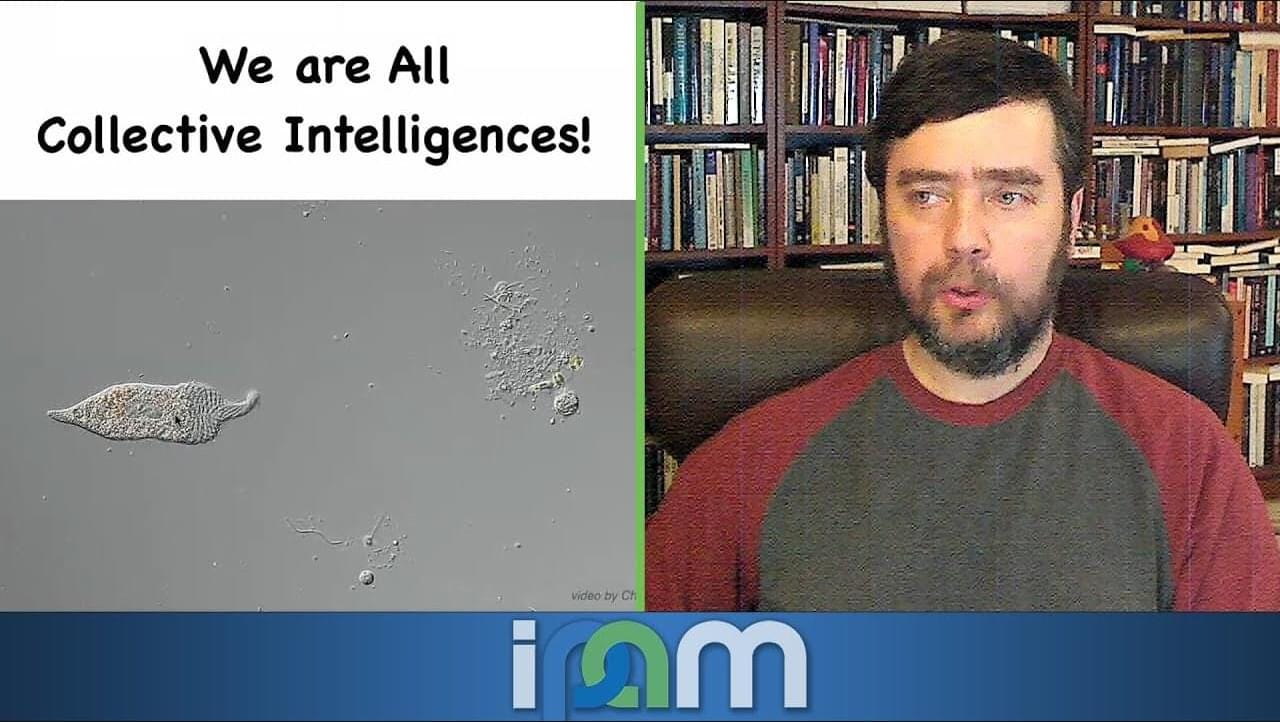
I hadn’t planned to write about Levin until I understood him far better, but with my last article here the name of Rupert Sheldrake came up in the comments (thanks for mentioning him!) and I realized I had a few basic things to write about Michael Levin and why I think he’s most definitely worth checking out.
Sheldrake thinks Levin is “one of the most creative biologists working today,”1 and he loves Levin’s “top-down” emphasis on fields and morphogenesis. Perhaps the main difference between the two is Sheldrake’s morphogenetic resonance fields are currently unfalsifiable, while Levin has already demonstrated some mind-blowing effects from his emphasis on bio-electricity inherent in living things.2 We perhaps ought to consider that Sheldrake’s model(s) underly Levin’s on a deeper level. Certainly Levin read Sheldrake’s A New Science of Life - he told Rupert he had - and that Levin’s research might provide a crucial bridge between the RNA-DNA materialistic model and the dogma around it, and Sheldrake’s morphogenetic fields, on which different fields of memory in natural systems nest inside others and interact with each other.
While in school, he had deep questions and hunches and drives, and often they were too weird for his teachers. They didn’t understand him, or thought his ideas were outmoded. In a 2020 oral history interview he was asked about trying to create a new field that his mentors didn’t understand:
Yeah, it’s an interesting question. I thought about this a lot, because when I was younger, one of things I was really interested in reading about was people on the fringes of mainstream science, both because they were studying something that nobody else was interested in, and the people that were was ahead of the curve. They had seen things that nobody else was willing to take on board at the time. And I read a lot about the history of it, both from their perspective and the history of what the field was doing at the time, in terms of trying to understand how does one make an impact with a novel and kind of unusual approach to things? And I think I learned a couple of things from that and also from my own interaction with people talking about my ideas at an early stage of the game. And what I think I learned is there’s a lot of inertia. And there’s a lot of resistance to new ideas. But it’s not because anybody is trying to hold it back or because there’s some establishment that hates new things. A lot of people on the margins of the mainstream have this adversarial view- that people are trying to actively hold them back. I don’t think any of that is the case; there’s no big conspiracy. Nobody’s trying to hold back new findings.3
Levin just thinks people are really busy with drilling deep down into established parameters of research, what Kuhn called “normal science.” They are being rewarded for research that has already been shown to be successful, and he understands the difficulties he’s faced. But from what I’ve been reading, the worm has turned. Or started to. Or the worm was cut in half and is growing a new head, etc…
Levin thinks intelligence is a fundamental property of all living systems. It’s not simple DNA as software telling RNA to create hardware - proteins - but there is a larger picture, in which bio-electricity helps to reduce errors in morphology.
“Understanding how tissues and organs encode and propagate anatomical information in electrical signals to fix or create very complex, specific structures is a fundamental challenge that we call ‘cracking the bioelectric code,’” said Levin. “It has the potential to advance not only biomedicine but multiple fields including robotics and AI, akin to how insights from neuroscience are being used to drive the development of neural nets and other computational tools, but in a much more general context.”4
When writing on people who are missing most of their brain and getting along in life just fine, I had a ton of notes, and Levin’s work with flatworms (planaria) was something I had to leave out, but let me briefly explain what he did: you create a stimulus with the planaria, which provokes a response. You can cut the worm in half, throw away the head and it will regenerate a new head that “remembers” what it had learned before. How? He’s published some papers on this. Understanding this leads to synthetic biology - he’s generated Xenobots (DARPA-funded), novel living systems, in order to understand how collectives of cells target information to create anatomically homeostatic morphology - which might possibly lead to regeneration of limbs in humans, like how lizards grow back their tail after you cut it off, etc.
He wants his research to tackle cancer. My general impression is that it’s revolutionary, holistic, paradigm-shattering. It harkens back to the early 19th century idea of electricity and LIFE!, and Mary Shelley’s Frankenstein, but Levin seems quite sober and fecund. His graduate work at Harvard medical school was on genetic expression in embryos from a quantum perspective.
I’m very much interested in bio-electricity and a semantic sense of the term epigenetics. The narrow view of epigenetics concerns mechanisms that modulate the DNA-RNA synthesis: in general, genes get switched on or off in response to environment, or relatively nudged up or down like a rheostat in response to something else outside the system. A larger semantics of “epigenetic” is anything that influences our bodies that is not strictly genetically based. The advent of writing would be epigenetic in this sense. So would Levin’s research, which accounts for genetic expression, but seems to go much further. This question would seem to apply to Sheldrake, too. Are Levin and/or Sheldrake engaged in work that is epigenetic?
I mentioned Robert O. Becker’s 1985 The Body Electric and its influence on Levin. Becker was preceded by Ray Bradbury’s I Sing The Body Electric, a collection of short stories from 1969, but Bradbury got it from Whitman, who wrote that phrase in 1855 or so, in Leaves of Grass. The earliest printing left that line out, because it was thought American readers didn’t know enough about electricity. It was restored in 1867. Here’s one of my favorite lines from that section of the poem:
The thin red jellies within you, within me — the
bones, and the marrow in the bones,
The exquisite realization of health,
O I say now these are not the parts and poems of
the body only, but of the Soul,
O I say these are the Soul!
There seems a shadow history of bio-electricity that is only now being resurrected, and Levin has had a lot to do with this.5 Harold Saxton Burr was at Yale for decades and worked under a bio-electrical paradigm lost. He co-wrote, in 1935, The Electro-Dynamic Theory of Life with the eminent FSC Northrop, whose 1931 book Science and First Principles was an influence on Alfred Korzybski. Northrop was also a huge player in the post-war Macy Conferences, which I will be writing about in the future.
To get a view of how Levin is (ahem!) not exactly a limited thinker, read “Platonic Space: Where Cognitive and Morphological Patterns Come From (Besides Genetics and Environment” from last March, 2025. If you read this, it tells you why I had been holding back in writing about Levin until I understood him better. Physicalism seems hopelessly incomplete to him, some sort of panpsychism would seem to be in order, not to mention mind-matter effects and quantum mechanics. The “Platonic-space” world stuff is what’s blowing my mind, as I had an overall view of Plato that must be overcome in order to understand Levin.
Time will tell how well Levin’s revolutionary visions for Biology cash out. I have picked him because, while I feel I don’t have an adequate purchase on his ideas of Platonic space and consciousness, etc, my intuition has been telling me this is the kind of thing that blows apart the sort of materialist paradigm that was ushered in by Watson, Crick, and Franklin. Their work was utterly revolutionary and has lead to many non-degenerating research programs, but clearly: the anomalies and big-time stumpers have been building up. I think the bio-electricity moment is upon us and it promises quite a lot. Will it solve the origin of life on this planet? Or how a complex molecule like RNA came to be in the first place?
Will it deliver?
A ginormous number of links to Levin and his colleague’s work is at the Levin Lab at Tufts.
You manage to hit the sweet spot here of writing about something I am completely ignorant about, so I can't really comment, but this is really interesting.
Terrific piece. I tend to think of “I Sing the Body Electric” as an anti-slavery poem even though it doesn’t bring up slavery explicitly until section seven.